
Last updated: July 2026 · Reviewed by Miguel Cibeira
This article is for informational purposes only and is not investment advice or tax advice. See our full Disclaimer for details.
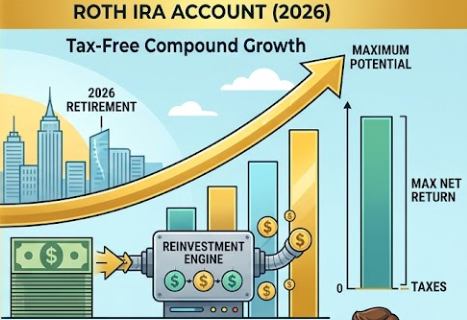
A Roth IRA doesn’t just change how you save for retirement — it can change which ETFs make the most sense to hold, because of how the account is taxed. Since qualifying Roth withdrawals in retirement are entirely tax-free, some funds that would create a tax drag in a regular taxable brokerage account become considerably more attractive inside a Roth. This guide walks through the 2026 Roth IRA rules briefly, then covers which ETF categories tend to make the most sense for this specific account type, and why.
If you’re new to ETFs generally, our What Is an ETF? guide covers the basics first.
2026 Roth IRA Rules, Briefly
Before getting into fund selection, a quick refresher on the account itself, based on current IRS figures for 2026:
- Contribution limit: $7,500 for those under 50; $8,600 for those 50 and older (including a $1,100 catch-up contribution).
- Income limits (MAGI): To contribute the full amount, single filers must have modified adjusted gross income under $153,000, and joint filers under $242,000. Contribution amounts phase out completely at $168,000 (single) and $252,000 (joint).
- Tax treatment: Contributions are made with after-tax dollars — no upfront deduction — but qualified withdrawals in retirement, including all investment growth, are entirely tax-free.
- Deadline: Contributions for a given tax year can generally be made until the federal tax filing deadline of the following year.
These figures are based on current IRS guidance and can change; always confirm current limits directly with the IRS or a tax professional, particularly if your income is near a phase-out threshold, since backdoor Roth strategies and partial contribution rules add complexity beyond what’s covered here.
Source: IRS, Roth IRAs (official contribution limits and income eligibility rules).
Why Fund Choice Can Differ Inside a Roth IRA
This is the part most “best ETFs” lists skip entirely. In a taxable brokerage account, you owe tax every year on dividends and, eventually, on capital gains when you sell. Inside a Roth IRA, none of that annual tax friction applies — dividends, interest, and capital gains all grow completely sheltered from tax, and qualified withdrawals in retirement owe nothing at all.
That difference changes the calculus for certain fund types. Investments that generate a lot of taxable income each year — high-yield funds, actively managed funds with higher turnover, REITs, and funds paying non-qualified dividends — create more of a tax burden in a taxable account than a fund like VOO, which pays a modest, mostly qualified dividend. Inside a Roth, that tax disadvantage disappears entirely, which is why some investors deliberately place their highest-tax-drag holdings inside tax-advantaged accounts like a Roth IRA, and hold their more tax-efficient funds (broad index funds with low turnover and mostly qualified dividends) in taxable accounts instead. This concept is often called “asset location,” and it’s a different question from asset allocation (how much of each asset class you own overall).
With that framing in mind, here are ETF categories that tend to make particularly good sense inside a Roth IRA specifically.
1. Broad Core Index Funds (VOO, VTI)
A broad index fund is a reasonable Roth holding under almost any circumstance — there’s no downside to tax-free growth on a fund like VOO or VTI. But because these funds already pay a low, mostly qualified dividend, they’re also relatively tax-efficient in a regular taxable account. In other words: great in a Roth, but not something you’re necessarily “wasting” by holding outside one either. We compare these two directly in our VOO vs VTI article.
Why it fits a Roth: Decades of compounded, entirely tax-free growth on a low-cost, diversified core holding.
2. High-Yield and Options-Income Funds (JEPI)
This is where account type matters most. JEPI’s covered-call strategy generates a high current yield — often in the 7%-8% range — but a meaningful portion of that income is typically taxed as ordinary income rather than at the lower qualified dividend rate. In a taxable account, that can mean a substantial annual tax bill on income you may not even be spending. Inside a Roth IRA, none of that matters — the entire distribution grows and can eventually be withdrawn tax-free.
Why it fits a Roth: Shelters JEPI’s higher-taxed distributions from annual tax exposure, which is one of the most commonly cited reasons investors specifically choose to hold funds like this in a Roth rather than a taxable account. We cover this fund in more detail in our JEPI vs SCHD comparison.
3. REIT ETFs
Real estate investment trust (REIT) ETFs are structurally required to distribute the large majority of their taxable income to shareholders, and most of that income does not qualify for the lower qualified-dividend tax rate — it’s generally taxed as ordinary income in a taxable account. That makes REIT funds another common candidate for “asset location” inside a Roth IRA specifically, for the same reason as JEPI: the tax-inefficient income gets sheltered entirely.
Why it fits a Roth: REIT dividends are typically taxed at higher ordinary income rates in a taxable account; a Roth eliminates that friction completely.
4. Growth-Focused Funds (QQQ, VUG, SCHG)
Growth funds pay minimal dividends, so the tax-efficiency argument that applies to JEPI or REITs doesn’t apply here in the same way. The case for growth funds in a Roth is different: because Roth withdrawals in retirement are entirely tax-free, and growth funds are specifically aiming for higher long-term appreciation, a dollar of growth compounding tax-free for decades in a Roth can be particularly valuable — you’re not just avoiding tax on dividends, you’re avoiding all capital gains tax on the appreciation too, permanently, as long as withdrawal rules are followed. We compare growth-focused funds in more detail in our Best Growth ETFs guide.
Why it fits a Roth: No tax owed, ever, on years of compounded appreciation — a meaningful advantage for a fund category specifically targeting long-term growth.
5. Dividend and Dividend Growth Funds (SCHD, VYM, DGRO)
These funds already pay mostly qualified dividends, meaning they’re relatively tax-efficient even in a taxable account. That said, holding them in a Roth still means never paying tax on that income at all, and reinvested dividends compound without any annual tax drag. Many investors hold dividend funds across both account types depending on how much Roth space they have available.
Why it fits a Roth: Solid, though not as clearly advantaged by account type as JEPI or REIT funds specifically, since the underlying dividends are already fairly tax-efficient to begin with.
What About International Funds (VXUS)?
International funds carry one Roth-specific wrinkle worth knowing: foreign governments sometimes withhold tax on dividends paid by foreign companies before they ever reach the fund. In a taxable account, U.S. investors can often claim a foreign tax credit to offset that withholding on their tax return. Inside a Roth IRA (or any IRA), that foreign tax credit generally isn’t available, because the account itself isn’t subject to U.S. tax in the first place — meaning the foreign withholding is simply a cost you can’t recover either way. This is a narrow, often-overlooked detail rather than a major factor, but it’s one reason some investors prefer to hold international funds like VXUS in a taxable account when they have the choice, and prioritize their Roth space for the fund types described above instead.
This is general information about how these mechanics typically work, not personalized tax advice — your specific tax treatment depends on your full financial picture, and a tax professional can confirm what applies to you.
A Sample Roth IRA Allocation (For Illustration Only)
The following is a hypothetical example to illustrate the asset-location concepts above — not a personalized recommendation, and not the “correct” allocation for any specific investor:
| Fund | Category | Illustrative Roth allocation |
|---|---|---|
| VTI or VOO | Core U.S. index | 40% |
| SCHD | Dividend/quality | 20% |
| QQQ or VUG | Growth | 20% |
| JEPI | High-yield income | 10% |
| A REIT ETF | Real estate income | 10% |
Your own allocation should reflect your age, timeline, risk tolerance, and overall financial picture — including what you hold in other accounts — rather than copying a generic example like this one.
Frequently Asked Questions
Can I hold any ETF in a Roth IRA? Most major brokerages allow you to hold the same range of ETFs in a Roth IRA as in a taxable brokerage account — there’s generally no restriction on fund type specific to the account itself. The question isn’t usually “can I,” it’s “does it make sense given how the account is taxed.”
Is it better to put growth ETFs or dividend ETFs in a Roth IRA? Both can make sense in a Roth, for different reasons — growth funds benefit from tax-free compounding of appreciation over time, while high-yield or tax-inefficient funds (like JEPI or REITs) benefit from having their otherwise higher-taxed distributions sheltered entirely. If you’re choosing between account types for different holdings, funds with the least tax-efficient income in a taxable account (JEPI, REITs) are the ones where a Roth typically makes the most relative difference.
Do I pay taxes on ETF dividends inside a Roth IRA? No. Dividends, interest, and capital gains inside a Roth IRA are not taxed annually, and qualified withdrawals in retirement are also tax-free, provided IRS rules for qualified distributions are met (generally requiring the account to be at least 5 years old and the account holder to be 59½ or older, with some exceptions).
What happens if I withdraw from a Roth IRA before retirement? Withdrawing investment earnings before meeting the qualified distribution requirements can trigger both income tax and a 10% penalty on the earnings portion, with some exceptions (such as certain first-time home purchases or specific hardship circumstances). Contributions themselves (not earnings) can generally be withdrawn at any time without tax or penalty, since they were made with after-tax dollars. Rules here are detailed — consult a tax professional before making an early withdrawal.
Should I max out my Roth IRA before investing in a taxable brokerage account? This depends on your full financial picture — emergency savings, other goals, employer retirement matching, and timeline all factor in. This article covers fund selection within a Roth IRA, not a comprehensive comparison of account prioritization; a financial advisor can help you think through the right order for your specific situation.
Can high earners still use a Roth IRA? Direct contributions phase out above certain income levels ($153,000-$168,000 for single filers and $242,000-$252,000 for joint filers in 2026), but many high earners use a “backdoor Roth” strategy — contributing to a traditional IRA and then converting it to a Roth — subject to its own set of IRS rules. This is a more complex strategy that a tax professional can help evaluate.
This article reflects Roth IRA contribution and income limits published by the IRS for the 2026 tax year and is provided for general informational purposes only — it is not personalized tax or investment advice. Contribution limits, income thresholds, and tax rules can change; always verify current figures directly with the IRS or a licensed tax professional before making contribution or investment decisions. Read our full Disclaimer and Privacy Policy for more information.
About the Author
Miguel Ángel Cibeira researches and writes every article on The Fund Atlas personally, sourcing data directly from fund issuers, the IRS, the SEC, and the Federal Reserve. He is not a licensed financial advisor, broker-dealer, or RIA — this site offers independent research and general information, not personalized financial advice. Read the full bio →