
Last updated: July 2026 · Reviewed by Miguel Cibeira
This article is for informational purposes only and is not investment advice. See our full Disclaimer for details.
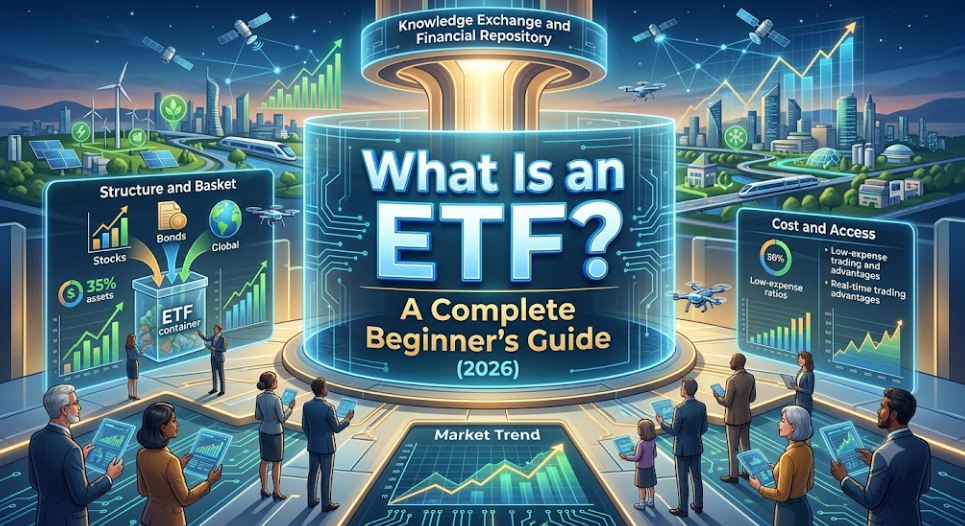
If you’ve read any of our fund comparisons — VOO vs VTI, SCHD vs VYM, or any of the “best ETFs” roundups on this site — and found yourself wondering what an ETF actually is at a mechanical level, this is the article to start with. Everything else on this site assumes you understand the basics covered here.
By the end of 2026, U.S.-listed ETFs held more than $15 trillion in combined assets, spread across roughly 4,500 individual funds — up from essentially zero before 1993. That growth isn’t an accident. ETFs solved a real problem for everyday investors, and understanding how they work makes every other comparison on this site easier to follow.
The Simple Definition
An ETF — short for exchange-traded fund — is a basket of investments (stocks, bonds, or other assets) that trades on a stock exchange, just like an individual share of Apple or Microsoft. When you buy one share of an ETF, you’re buying a small slice of everything that fund holds, all in a single transaction.
For example, buying one share of VOO gives you indirect ownership of a slice of roughly 500 different companies — from the largest technology firms to smaller S&P 500 constituents — without having to buy 500 individual stocks yourself.
That’s the entire concept in one sentence: an ETF lets you buy diversified exposure to many assets at once, in a single trade, at a share price you can watch move throughout the trading day.
How ETFs Actually Work
Understanding the mechanics behind an ETF helps explain why they tend to be cheap, tax-efficient, and easy to trade — three qualities that aren’t accidental, but built into the structure itself.
1. The fund holds a basket of assets
An ETF issuer (Vanguard, BlackRock/iShares, Schwab, Invesco, and others) creates a fund designed to hold a specific set of assets — usually defined by an index it’s trying to track, like the S&P 500 or the Nasdaq-100. The fund buys and holds those underlying securities.
2. Shares are created and redeemed in bulk
This is the part that differs most from a regular company stock. Large institutional players called “authorized participants” can exchange a big basket of the underlying securities for a large block of new ETF shares (called a “creation unit”), or do the reverse — hand back ETF shares in exchange for the underlying securities. This creation/redemption process is what keeps an ETF’s share price closely aligned with the actual value of what it holds, and it’s also the mechanism that makes ETFs more tax-efficient than traditional mutual funds, which we’ll get to below.
3. Shares trade on an exchange all day
Once created, ETF shares trade on a stock exchange (like the NYSE or Nasdaq) throughout the trading day, just like any individual stock. You can buy or sell at any point the market is open, and the price moves in real time based on supply, demand, and the changing value of the fund’s underlying holdings.
4. The fund tracks an index (usually)
Most ETFs are “passively managed,” meaning they aim to replicate the performance of a specific index rather than have a manager actively picking investments. VOO aims to match the S&P 500’s performance. BND aims to match a broad U.S. bond index. The fund’s job is tracking accuracy, not beating the market.
ETFs vs. Mutual Funds: What’s the Difference?
ETFs and mutual funds are often confused because both pool money from many investors into a diversified basket of assets. The differences come down to structure and trading:
| Feature | ETFs | Mutual Funds |
|---|---|---|
| How you trade | Buy/sell anytime during market hours, like a stock | Bought/sold once per day, after market close |
| Minimum investment | Often the price of one share (or less, with fractional shares) | Sometimes requires a minimum ($1,000–$3,000+) |
| Typical expense ratios | Often lower, especially for index funds | Often higher, especially for actively managed funds |
| Tax efficiency | Generally more tax-efficient due to the creation/redemption process | Can generate more taxable capital gains distributions |
| Price transparency | Real-time price throughout the day | Priced once daily at net asset value (NAV) |
Neither structure is universally “better” — but for a simple, low-cost, buy-and-hold index strategy, the ETF structure has become the default choice for most new investors over the past decade, which is part of why ETF assets have grown so quickly relative to mutual funds.
ETFs vs. Individual Stocks
Buying an individual stock means betting on one company. Buying an ETF means spreading that same amount of money across every company the fund holds.
The trade-off is straightforward: an individual stock can dramatically outperform (or underperform) the market, while a broad ETF is designed to move roughly in line with whatever it tracks. Neither approach is inherently right or wrong — many investors use both, holding a core of diversified ETFs alongside a smaller allocation to individual stocks they have a specific view on.
Main Types of ETFs
“ETF” describes a structure, not a single strategy. Here are the broad categories you’ll run into most often — and most of the comparisons on this site fall into one of these buckets.
Broad market index ETFs — Track a wide index like the S&P 500 (VOO) or the total U.S. stock market (VTI). Designed to be a simple, diversified core holding.
Sector ETFs — Focus on a single industry, such as technology, energy, or healthcare. More concentrated, and more sensitive to how that specific sector performs.
Dividend ETFs — Focus on companies that pay dividends, using different selection criteria (current yield, dividend growth history, quality screens). SCHD, VYM, and VIG are common examples.
Bond ETFs — Hold a basket of bonds instead of stocks, generally used to reduce portfolio volatility and generate income. BND is a widely held example.
International/global ETFs — Provide exposure outside the U.S., either broadly (VXUS) or focused on a specific region or country.
Sector-specific commodity or thematic ETFs — Track a specific asset (like gold) or a narrow investment theme (like semiconductors or clean energy).
Actively managed ETFs — Unlike index-tracking funds, these have a manager making ongoing decisions about what to hold, aiming to outperform a benchmark rather than simply track it. JEPI is a well-known example, using an options-based income strategy rather than passive index tracking.
Leveraged and inverse ETFs — Designed to amplify daily returns (2x or 3x an index) or move opposite to an index. These are considerably higher-risk, generally intended for short-term trading rather than long-term holding, and behave very differently from a simple index fund over time due to daily rebalancing effects.
Cryptocurrency ETFs — A newer category providing exposure to assets like Bitcoin (IBIT) through a regulated fund structure, without requiring a separate crypto wallet or exchange account.
Understanding Expense Ratios
Every ETF charges an annual fee, called the expense ratio, expressed as a percentage of your investment. It’s automatically deducted from the fund’s assets — you won’t see a separate bill, but it does reduce your returns slightly every year.
To put the numbers in perspective: a 0.03% expense ratio (typical for a broad index fund like VOO or VTI) costs about $3 per year on a $10,000 investment. A 0.75% expense ratio — more typical of some actively managed or thematic funds — costs $75 per year on that same $10,000. That gap looks small in any single year, but compounded over 20 or 30 years, it can meaningfully affect your total return, since the fee is deducted every single year regardless of how the fund performs.
As a general rule, the more “passive” and broad an ETF is, the lower its expense ratio tends to be. The more specialized, actively managed, or complex the strategy, the higher the fee usually runs.
Dividends and Distributions
Many ETFs — especially those holding dividend-paying stocks or bonds — pass along the income generated by their underlying holdings to shareholders, usually on a quarterly basis (some funds distribute monthly). Whether or not an ETF pays a meaningful dividend depends entirely on what it holds: a broad-market fund like VTI pays a modest dividend reflecting the average yield of the whole market, while a dedicated dividend ETF like SCHD is specifically built to maximize that income component.
Dividend payments from most standard ETFs are typically classified as “qualified dividends,” which are taxed at more favorable long-term capital gains rates rather than ordinary income tax rates — though this depends on your specific holding period and the fund’s underlying income sources. This is general tax information, not personalized advice; consult a tax professional about your specific situation.
Why ETFs Are Considered Tax-Efficient
This comes back to the creation/redemption mechanism described earlier. When large institutional investors redeem ETF shares, they typically receive the underlying securities “in kind” rather than cash, which allows the fund to avoid selling appreciated securities and realizing a taxable capital gain in the process. Traditional mutual funds, which handle redemptions with cash, don’t have this same structural advantage, and can end up distributing taxable capital gains to all shareholders — even ones who didn’t sell anything that year.
This doesn’t mean ETFs are immune to taxes. You’ll still owe tax on dividends received and on capital gains when you eventually sell your own shares at a profit. But the fund structure itself tends to generate fewer unexpected taxable events along the way compared to a mutual fund holding similar assets.
Risks of Investing in ETFs
ETFs are a structure, not a guarantee of safety. The risk of any specific ETF depends entirely on what it holds:
- Market risk — A broad stock ETF will fall in value during a market downturn, just like the stocks it holds.
- Concentration risk — Sector, thematic, and some dividend ETFs can be more concentrated in specific industries or companies than a broad index fund, which can amplify both gains and losses.
- Interest rate risk — Bond ETFs are sensitive to interest rate changes; rising rates generally push existing bond prices down.
- Liquidity risk — Extremely niche or newly launched ETFs can have lower trading volume, which may result in wider bid-ask spreads and higher effective trading costs.
- Leveraged/inverse fund risk — These are structurally designed for short-term use and can behave in ways that surprise long-term holders due to daily rebalancing; they carry meaningfully higher risk than a standard index ETF.
- Tracking error — Even index ETFs don’t perfectly replicate their benchmark every single day, due to fees, cash drag, and sampling methods, though this gap is typically small for large, established funds.
An ETF wrapper can make a risky underlying strategy easier to access, but it doesn’t make that underlying strategy safe. Always look at what a fund actually holds, not just its ticker or category label.
How to Buy Your First ETF
- Open a brokerage account. Most major U.S. brokers now offer commission-free ETF trading.
- Fund the account. Transfer money from a linked bank account.
- Decide which account type fits your goal — a taxable brokerage account for flexible access, or a tax-advantaged account like a Roth or traditional IRA for retirement savings, each with different tax rules.
- Search for the ETF by ticker (for example, VOO or SCHD) inside your brokerage’s trading platform.
- Place an order — most brokers let you choose between a market order (executes immediately at the current price) or a limit order (executes only at a price you specify).
- Decide on a contribution pattern. Many long-term investors set up automatic, recurring purchases rather than trying to time individual trades.
This is a general walkthrough of the mechanical steps involved, not a recommendation of which specific ETF, broker, or account type is right for you — that depends on your individual financial situation and goals.
A Brief History of ETFs
The first U.S. ETF, SPDR S&P 500 ETF Trust (SPY), launched in 1993, tracking the S&P 500. For years, ETF growth was modest compared to mutual funds. That changed dramatically over the following two decades as expense ratios fell, more specialized fund types launched (bond ETFs in 2002, commodity ETFs in 2004), and investor awareness grew.
By the end of 2025, the U.S. ETF industry held roughly $13.4 trillion in assets across nearly 4,500 funds. Growth accelerated further into 2026, with total U.S. ETF assets surpassing $15 trillion — driven by continued inflows into core index funds, rapid growth in actively managed ETFs, and the emergence of newer categories like spot cryptocurrency ETFs. Three firms — BlackRock (iShares), Vanguard, and State Street — now manage roughly three-quarters of all U.S. ETF assets combined, reflecting how concentrated the “core” end of the market has become even as the total number of available funds keeps expanding.
Frequently Asked Questions
Is an ETF the same as a stock? Not exactly, though they trade the same way. A single stock represents ownership in one company. A single ETF share represents a proportional slice of everything the fund holds — which could be hundreds or thousands of underlying securities, depending on the fund.
Are ETFs safe? “Safe” depends entirely on what the ETF holds. A broad, diversified index ETF spreads risk across many companies, which reduces the impact of any single company underperforming — but it’s still subject to overall market risk and can lose value. A leveraged or highly concentrated ETF carries meaningfully more risk than a broad index fund. There is no ETF that guarantees you won’t lose money.
How much money do I need to start investing in ETFs? Many brokers now offer commission-free trading and fractional shares, which means you can often start with a small amount of money — sometimes as little as $1, depending on the platform and fund.
Do ETFs pay dividends? Many do, particularly those holding dividend-paying stocks or bonds, though the amount depends entirely on what the fund holds. Growth-focused or non-dividend-paying stock ETFs may pay little to nothing in dividends.
What’s the difference between an index ETF and an actively managed ETF? An index ETF aims to track a specific benchmark as closely as possible, with minimal ongoing decision-making. An actively managed ETF has a manager or team making ongoing decisions about what to hold, aiming to outperform a benchmark — typically at a higher expense ratio than a comparable index fund.
Can an ETF go to zero? It’s extremely unlikely for a broad, diversified ETF holding hundreds of established companies to lose all its value, though it’s not theoretically impossible. Highly concentrated or leveraged ETFs carry meaningfully more risk of severe, rapid losses than a broad index fund.
How do I know if an ETF is a good fit for me? That depends on your goals, timeline, and risk tolerance — factors specific to your own financial situation. This article explains how ETFs work generally; it isn’t a recommendation of any specific fund. A licensed financial advisor can help evaluate what fits your personal circumstances.
What happens to an ETF if the company managing it goes out of business? The underlying assets in the fund are legally held separately from the issuer’s own corporate assets (typically in a trust structure), which is designed to protect fund holdings even if the issuer faces financial trouble. However, an ETF can still be closed or liquidated by its issuer for business reasons (such as insufficient investor demand), in which case shareholders typically receive a cash payout equal to the fund’s net asset value at the time of closure.
Is it better to invest in one ETF or several? Both are common approaches. A single broad fund like VTI can serve as a complete, diversified “one-fund” portfolio on its own. Combining several funds — for example, a U.S. index fund, an international fund, and a bond fund — lets you control your own allocation across asset classes, at the cost of a bit more complexity to manage.
This article is provided for general informational and educational purposes only and is not a recommendation to buy or sell any security. Industry statistics referenced above reflect publicly available data as of the “last updated” date and are subject to change. Always do your own research and consult a licensed financial advisor before making investment decisions. Read our full Disclaimer and Privacy Policy for more information.
About the Author
Miguel Ángel Cibeira researches and writes every article on The Fund Atlas personally, sourcing data directly from fund issuers, the IRS, the SEC, and the Federal Reserve. He is not a licensed financial advisor, broker-dealer, or RIA — this site offers independent research and general information, not personalized financial advice. Read the full bio →