
Last updated: July 2026 · Reviewed by Miguel Cibeira
This article is for informational and educational purposes only and is not investment advice. See our full Disclaimer for details.
Dividends come up constantly across this site — in our Best Dividend ETFs guide, our SCHD vs VYM comparison, and throughout our coverage of income-focused funds. This article steps back to cover the basics: what a dividend actually is, how the payment process works mechanically, and why some companies pay them while others don’t.
The Basic Definition
A dividend is a portion of a company’s profits distributed directly to shareholders, typically in cash, as a way of sharing the company’s earnings with the people who own its stock. If you own 100 shares of a company that pays a $0.50 per-share quarterly dividend, you’d receive $50 that quarter, deposited into your brokerage account (or, if you’ve elected automatic reinvestment, used to purchase additional shares).
Dividends are decided by a company’s board of directors, not guaranteed by any regulation or contract — a company can raise, cut, suspend, or eliminate its dividend at any time based on its financial situation and board decisions, which is an important distinction from something like a bond’s fixed interest payment.
Source: U.S. Securities and Exchange Commission, Investor.gov glossary (official definition of a dividend).
Why Do Companies Pay Dividends?

Not every profitable company pays a dividend, and the decision reflects a real trade-off in how a company chooses to use its profits. Broadly, a company can do one or more of the following with earnings: reinvest them into the business (research, expansion, acquisitions), pay down debt, buy back its own shares, or distribute them to shareholders as a dividend.
Mature, established companies with fewer high-return internal investment opportunities often favor dividends as a way to return excess cash to shareholders — this is part of why traditional dividend-paying sectors like consumer staples, utilities, and financials, covered in our Best Sector ETFs guide, tend to include many of the market’s most consistent dividend payers.
Younger, high-growth companies more often reinvest all available profits back into the business, betting that internal growth investments will generate a better return than distributing cash to shareholders — which is part of why growth-oriented funds like those covered in our Best Growth ETFs guide typically show much lower dividend yields than dividend-focused funds like SCHD.
Neither approach is inherently better — it reflects a company’s specific stage, industry, and capital allocation strategy.
The Four Key Dates in a Dividend Payment
Understanding a dividend payment means understanding four specific dates, each serving a distinct purpose in the process:
1. Declaration date — The date a company’s board of directors formally announces the dividend, including its size and the other key dates below. This is typically announced via press release.
2. Ex-dividend date — The first date on which a stock trades without its next dividend attached. If you buy shares on or after the ex-dividend date, you will not receive the upcoming dividend payment — the seller retains that right instead. Under the current T+1 settlement cycle used in U.S. markets, the ex-dividend date is typically set one business day before the record date.
3. Record date — The date a company checks its official shareholder records to determine exactly who will receive the dividend. You must be a shareholder of record — meaning your purchase has settled — by this date to qualify.
4. Payment date — The date the dividend is actually paid out, either deposited into your brokerage account as cash or used to purchase additional shares if you’ve enrolled in a dividend reinvestment plan.
A simplified example: A company declares a $0.40 per-share dividend on March 2, with an ex-dividend date of March 16, a record date of March 16, and a payment date of March 17. An investor who owned shares before March 16 receives the dividend on March 17; an investor who buys on or after March 16 does not receive that particular payment, though they’d be eligible for the next one.
Why a Stock’s Price Often Drops on the Ex-Dividend Date
This regularly confuses new investors: it’s common to see a dividend-paying stock’s price drop by roughly the dividend amount on the ex-dividend date, even with no negative news about the company. This isn’t a random coincidence or a sign of trouble — it’s a mechanical adjustment. Once a stock goes “ex-dividend,” new buyers are no longer entitled to that specific payment, so the stock is effectively worth slightly less to a new buyer than it was the day before (when purchasing it still came with a claim to the upcoming dividend). The price adjustment reflects that change in what a share actually entitles its new owner to, not a change in the underlying value of the business itself.
Cash Dividends vs. Other Types
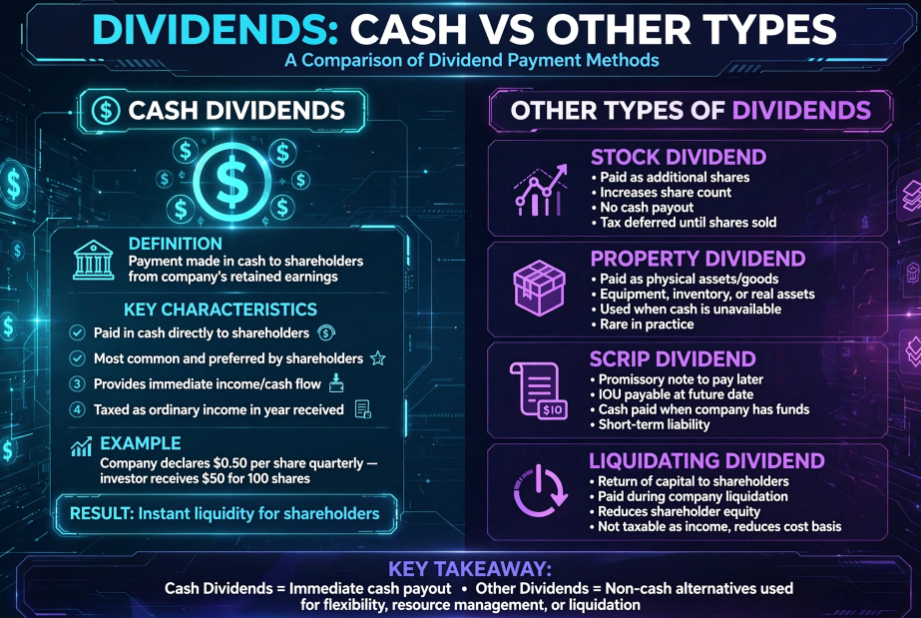
Cash dividends are by far the most common type — a direct cash payment per share, which is what this article and most dividend-focused discussion on this site refers to by default.
Stock dividends distribute additional shares instead of cash, proportionally increasing the number of shares each shareholder holds without changing their overall percentage ownership of the company.
Special dividends are one-time payments outside a company’s regular dividend schedule, often issued after an unusually strong period of earnings, an asset sale, or another event generating excess cash the company doesn’t have an immediate reinvestment plan for. Special dividends shouldn’t be assumed to repeat — they’re explicitly non-regular by nature.
Dividend Reinvestment (DRIP)
Many brokerages and funds offer an automatic dividend reinvestment option, often called a DRIP, which uses your dividend payments to automatically purchase additional shares (or fractional shares) of the same stock or fund, rather than depositing the cash into your account. Over long periods, reinvested dividends can meaningfully compound a portfolio’s growth, since each reinvested payment buys more shares, which then generate their own future dividends — a compounding effect distinct from, but related to, the fee-compounding math covered in our What Is an Expense Ratio? guide.
How Dividends Work Inside an ETF
When you hold a dividend ETF like SCHD or VYM rather than individual stocks directly, the fund collects the dividends paid by all of its underlying holdings and passes them along to fund shareholders, typically on a quarterly basis (some funds, covered in our Best ETFs for Monthly Dividend Income guide, distribute monthly instead). The mechanics of declaration, ex-dividend, record, and payment dates apply to the ETF itself, separate from — though ultimately funded by — the dividend schedules of the individual companies it holds.
Qualified vs. Non-Qualified Dividends: A Brief Note
Dividends aren’t all taxed the same way. Most dividends from U.S. stocks held for a sufficient period are considered “qualified” and taxed at the more favorable long-term capital gains rates, while dividends from certain sources — including REITs, covered in our Best REIT ETFs guide — are typically “non-qualified” and taxed as ordinary income. This distinction is significant enough that we cover it in dedicated depth across our Best ETFs for a Roth IRA and Best ETFs for a Taxable Brokerage Account guides.
Dividend Growth vs. Dividend Cuts: What the History Tells You
A company’s track record of dividend payments over time is often treated as a signal, though an imperfect one, of financial health and management discipline. Companies that have raised their dividend consistently for many consecutive years — a pattern specifically screened for by funds like VIG, covered in our Best Dividend ETFs guide — are sometimes viewed as demonstrating financial stability, since sustaining and growing a dividend commitment year after year, through different economic conditions, requires consistent underlying profitability.
That said, a long dividend history is not a guarantee against a future cut. Company circumstances change, and even companies with decades-long dividend growth streaks have occasionally reduced or suspended payments during periods of severe financial stress. A dividend track record is useful context, not a promise about the future.
Frequently Asked Questions
Are dividends guaranteed? No. A company’s board of directors can raise, lower, suspend, or eliminate a dividend at any time, generally based on the company’s financial performance and cash needs. Even companies with long histories of consistent dividend payments have cut or suspended dividends during severe financial distress.
Do all stocks pay dividends? No — many companies, particularly younger, high-growth companies, choose to reinvest all profits into the business rather than paying a dividend. A broad market fund like VTI will include a mix of dividend payers and non-payers, reflected in its overall (generally modest) yield.
If I buy a stock right before the ex-dividend date, do I get the dividend? No — to receive an upcoming dividend, you generally need to purchase (and have that purchase settle) before the ex-dividend date, not merely before the payment date. Buying on or after the ex-dividend date means the seller, not you, receives that specific payment.
Why did a stock’s price drop right after paying a dividend? This is typically the mechanical ex-dividend price adjustment described above — the stock is worth slightly less to a new buyer once it no longer carries the right to that specific dividend payment, not necessarily a sign of any underlying problem with the company.
What’s the difference between a dividend and a stock buyback? Both are ways a company returns value to shareholders, but they work differently. A dividend is a direct cash payment to shareholders. A stock buyback involves the company purchasing its own shares on the open market, which reduces the total number of outstanding shares and can increase the value of each remaining share, without a direct cash payment to shareholders.
Should I automatically reinvest my dividends? This depends on your goals — automatic reinvestment (DRIP) can support long-term compounding growth for investors who don’t need the current income, while investors who specifically want dividends as spendable income (such as in retirement) may prefer to receive them as cash instead. This is a personal decision based on your financial situation, not a universal rule.
This article is provided for general informational and educational purposes only and is not a recommendation to buy or sell any security. Dividend payment mechanics, including current settlement timelines, are subject to change based on market regulations. Always verify a specific company or fund’s actual dividend dates directly through its investor relations page or your brokerage before making decisions based on dividend timing. Read our full Disclaimer and Privacy Policy for more information.
About the Author
Miguel Ángel Cibeira researches and writes every article on The Fund Atlas personally, sourcing data directly from fund issuers, the IRS, the SEC, and the Federal Reserve. He is not a licensed financial advisor, broker-dealer, or RIA — this site offers independent research and general information, not personalized financial advice. Read the full bio →