
Last updated: August 2026 · Reviewed by Miguel Cibeira
This article is for informational and educational purposes only and is not tax advice. Tax rules and rates referenced below are current as of the “last updated” date and can change — consult a licensed tax professional for guidance specific to your situation.
Nearly every dividend-focused article on this site — What Is a Dividend?, Best Dividend ETFs, Best ETFs for a Roth IRA — references “qualified” versus “non-qualified” dividends without spelling out the full mechanics. This article is the complete version: exactly how the IRS decides which category your dividends fall into, the holding-period rule that catches more investors than you’d expect, and a real dollar comparison showing just how large the tax gap between the two categories actually is.
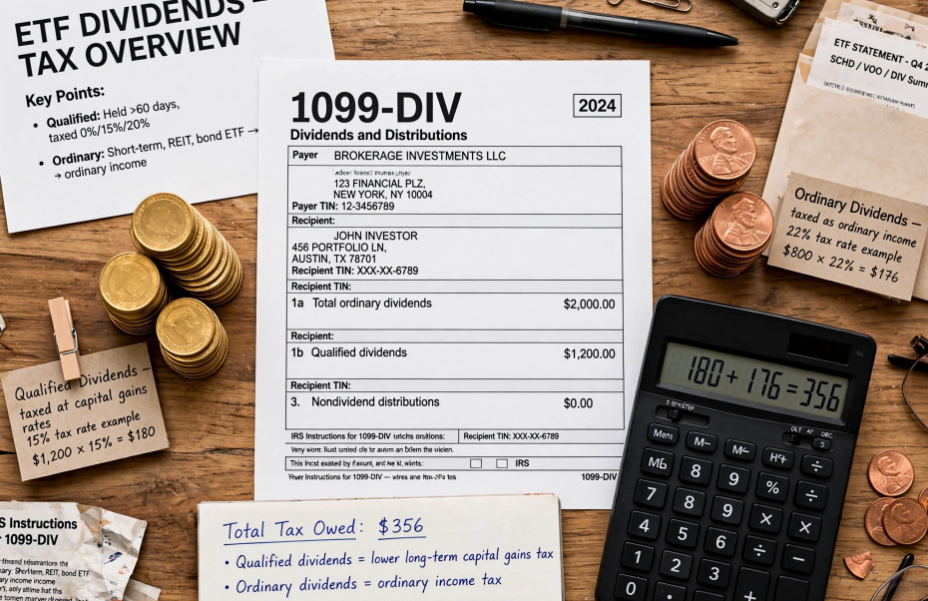
The Basic Split
Dividends paid out by ETFs fall into one of two tax categories:
Qualified dividends are taxed at the lower long-term capital gains rates — 0%, 15%, or 20%, depending on your taxable income and filing status.
Non-qualified (ordinary) dividends are taxed at your regular marginal income tax rate — the same rate that applies to your wages, up to 37% at the top bracket.
The distinction is purely about tax treatment, not about the underlying investment’s quality — the cash lands in your account the same way either way. What changes is how much of it you actually keep after taxes, and the gap between the two rates is large enough that it’s worth understanding exactly how the classification works.
Source: IRS, Topic No. 404 – Dividends (official rate table for qualified vs. ordinary dividends).
The Two Requirements for “Qualified” Status
For a dividend to qualify for the lower tax rate, two separate conditions both have to be met:
1. The payer must be eligible. The dividend must come from a U.S. corporation or a “qualified foreign corporation” — in practice, this covers the large majority of dividends from U.S.-listed stocks and most developed-market foreign companies.
2. You must satisfy the holding period requirement. This is the part that trips up more investors than the payer eligibility rule, and it deserves its own explanation.
The Holding Period Rule, Explained
To have a dividend treated as qualified, you generally need to hold the underlying shares — or, in the case of an ETF, the ETF shares themselves — for more than 60 days during a 121-day window that begins 60 days before the ex-dividend date (a concept covered in more detail in our What Is a Dividend? guide). For preferred stock specifically, the requirement is longer: more than 90 days during a 180-day window beginning 90 days before the ex-dividend date.

A worked example: Say a fund’s ex-dividend date is March 15. The 121-day window runs from roughly January 14 through May 15 (60 days on either side of the ex-dividend date). To have that specific dividend treated as qualified, you’d need to hold the shares for more than 60 total days within that window — which doesn’t require buying 60 days in advance specifically, but does require your combined holding period before and after the ex-dividend date to exceed 60 days.
The detail most investors miss: this holding period requirement applies to you personally, not just to the fund. Even if your ETF’s issuer reports a dividend as “qualified” on the fund’s own tax reporting — reflecting that the fund itself held its underlying stocks long enough — if you bought and sold your ETF shares within 60 days around the ex-dividend date, your specific portion of that dividend is treated as non-qualified on your own tax return, regardless of what the fund’s paperwork says. For the large majority of buy-and-hold investors covered throughout this site, this requirement is satisfied automatically without any special effort — it only becomes a real issue for investors trading ETFs frequently or buying shares specifically to capture a dividend right before the ex-dividend date and then selling shortly after.
2026 Tax Rates on Qualified Dividends
Based on current IRS guidance for the 2026 tax year, qualified dividends are taxed at:
- 0% for taxable income up to roughly $49,450 (single filers) or $98,900 (married filing jointly)
- 15% for income above those thresholds, up to roughly $545,500 (single) or $613,700 (married filing jointly)
- 20% for income above those upper thresholds
High earners should also factor in the Net Investment Income Tax (NIIT) — an additional 3.8% surtax on investment income once modified adjusted gross income exceeds $200,000 (single) or $250,000 (married filing jointly), covered in more depth in our Best ETFs for a Taxable Brokerage Account guide. For a high earner, this effectively pushes the top qualified dividend rate to roughly 18.8% or 23.8% combined, depending on which threshold applies.
Non-qualified dividends, by contrast, are simply taxed at your regular marginal income tax bracket — which can run as high as 37% at the top federal bracket, before even factoring in the NIIT surtax on top of that for high earners.
Source: IRS, Topic No. 409 – Capital Gains and Losses, and Topic No. 559 – Net Investment Income Tax. Income thresholds are adjusted annually; verify current-year figures directly on irs.gov.
Seeing the Gap in Real Dollars
Abstract percentages are easier to internalize with an actual example attached. Consider an investor in the 32% marginal tax bracket who receives $3,000 in a single year from a bond ETF, where — as covered in our Best Bond ETFs guide — interest income is generally taxed as ordinary income rather than as a qualified dividend. That investor would owe roughly $960 in federal tax on that $3,000. If that same $3,000 had instead come from qualified stock dividends taxed at the 15% qualified rate, the tax bill would be only $450 — a difference of $510 on the exact same dollar amount of income, purely due to how it’s classified.
This is precisely the mechanical reasoning behind the asset-location strategy covered throughout our Best ETFs for a Roth IRA and Best ETFs for a Taxable Brokerage Account guides: funds that generate a large share of non-qualified income create meaningfully more tax drag in a taxable account than funds generating mostly qualified dividends, holding the pre-tax income amount constant.
What Typically Generates Non-Qualified Income
A handful of ETF categories reliably produce non-qualified income, regardless of how long you hold them:
Bond ETFs — Interest income distributed by bond funds like BND or AGG is taxed as ordinary income, not as a dividend at all in the qualified-dividend sense, as covered in our Best Bond ETFs guide.
REIT ETFs — Because REITs are legally required to distribute at least 90% of their taxable income to shareholders, and that income comes primarily from rental revenue and mortgage interest rather than corporate profit, the large majority of REIT dividend income — including from funds like VNQ, covered in our Best REIT ETFs guide — is non-qualified.
Money market funds — Income here is treated as ordinary interest income, not a qualified dividend.
Actively managed, options-based income funds — As covered in our Best ETFs for Monthly Dividend Income guide, funds like JEPI and JEPQ generate a meaningful share of their income from options premiums, which is typically taxed as ordinary income rather than qualified dividends.
A partial exception worth knowing: the Tax Cuts and Jobs Act introduced a deduction of up to 20% on certain qualified REIT dividend income for some taxpayers (sometimes referred to as the Section 199A deduction), which can meaningfully soften — though not eliminate — the ordinary-income tax treatment REIT distributions otherwise receive. This is a genuinely detailed area of tax law where a tax professional’s guidance is worth seeking if REIT income makes up a meaningful part of your portfolio.
The Foreign Tax Credit Wrinkle
As covered in our Best ETFs for a Roth IRA guide, international funds like VXUS often have foreign governments withhold tax on dividends before that income ever reaches the fund. In a taxable account, U.S. investors can generally claim a foreign tax credit to offset that withholding on their own tax return. Inside an IRA — Roth or traditional — that credit generally isn’t available, since IRA income isn’t reported on your annual return until withdrawal (if ever, in the case of a Roth). This is one of the more specific, often-overlooked arguments for holding international funds in a taxable account specifically, where the credit can actually be captured, rather than inside a tax-advantaged account where the withheld foreign tax is simply an unrecoverable cost either way.
Where to Find This on Your Tax Documents
Your broker issues a Form 1099-DIV each year for any taxable account holding dividend-paying investments, which separates your total dividend income into qualified and non-qualified (ordinary) amounts — typically reported in different boxes on the form (commonly Box 1a for total ordinary dividends and Box 1b for the qualified portion within that total). This form does the classification work for you in most cases, reflecting the fund’s own determination of what portion of its distributions qualified — though, as covered above, it’s still worth confirming your own holding period was long enough if you traded actively around a specific ETF’s ex-dividend date, since the fund’s reporting doesn’t necessarily account for your individual trading pattern.
Source: IRS Instructions for Form 1099-DIV.
Why This Matters for Fund and Account Selection
This isn’t purely academic — it connects directly to two decisions covered throughout this site. Fund selection: an ETF’s underlying tax character (mostly qualified vs. mostly ordinary income) is worth weighing alongside its yield and expense ratio, not treated as an afterthought, since two funds with an identical headline yield can produce very different after-tax income. Account placement: as covered in our Best ETFs for a Roth IRA and Best ETFs for a Taxable Brokerage Account guides, funds generating mostly non-qualified income are frequently better suited to a tax-advantaged account, where the ordinary-income tax treatment doesn’t apply annually, while funds with mostly qualified dividends are more tax-efficient candidates for a taxable account either way.
Frequently Asked Questions
Are all ETF dividends taxed the same way? No — it depends on both what the fund holds (a stock ETF’s dividends are often qualified; a bond or REIT ETF’s income is typically not) and how long you personally held the ETF shares around the relevant ex-dividend date.
If my broker’s 1099-DIV says a dividend is qualified, is that guaranteed to be correct for my tax return? Generally yes for typical buy-and-hold investors, but not always — the fund’s own reporting reflects what portion of its underlying income qualified based on its own holdings, and it may not fully account for your specific, individual holding period if you bought or sold shares close to the ex-dividend date. Frequent traders in particular should double-check their own holding period against the 60-day rule.
Why do REIT ETFs pay non-qualified dividends? Because REITs are legally required to distribute at least 90% of their taxable income, primarily sourced from rental income and mortgage interest rather than ordinary corporate profit, which doesn’t meet the IRS criteria for qualified dividend treatment — though a partial deduction under current tax law can reduce the effective rate for some taxpayers.
Does the qualified dividend holding period reset every time I buy more shares? The holding period is generally evaluated per tax lot (each individual purchase), not for your account as a whole — meaning shares you’ve held long enough can qualify even if you’ve also made more recent purchases of the same fund that haven’t yet met the holding period themselves.
Is it better to hold bond ETFs in a Roth IRA because of this tax treatment? Many investors specifically prioritize this, since bond interest is taxed as ordinary income annually in a taxable account, while a Roth IRA shelters that income from annual taxation entirely — a concept covered in more depth in our Best ETFs for a Roth IRA guide. This is general information, not a personalized recommendation.
Can non-qualified dividend income push me into a higher tax bracket? Yes — because non-qualified dividends are taxed as ordinary income, they stack on top of your other income (wages, for example) for bracket purposes, which can matter if the additional income pushes a portion of your earnings into a higher marginal bracket.
This article is provided for general informational and educational purposes only and does not constitute personalized tax advice. Tax rates, thresholds, and rules referenced above reflect current IRS guidance for the 2026 tax year and are subject to change — always verify current figures directly with the IRS and consult a licensed tax professional before making decisions based on dividend tax treatment. Read our full Disclaimer and Privacy Policy for more information.
About the Author
Miguel Ángel Cibeira researches and writes every article on The Fund Atlas personally, sourcing data directly from fund issuers, the IRS, the SEC, and the Federal Reserve. He is not a licensed financial advisor, broker-dealer, or RIA — this site offers independent research and general information, not personalized financial advice. Read the full bio →