
Last updated: July 2026 · Reviewed by Miguel Cibeira
This article is for informational and educational purposes only and is not investment advice. See our full Disclaimer for details.
Our VTI vs VXUS guide mentions emerging markets as part of broad international diversification, but the category deserves its own explanation — it’s more concentrated, more volatile, and defined more subjectively than most investors realize. This article covers what “emerging market” actually means, who decides which countries qualify, and a concentration issue inside emerging-market index funds that surprises a lot of investors expecting broad diversification.

The Basic Definition
“Emerging markets” describes countries with economies and financial markets that are developing — more established than the least-developed “frontier markets,” but not yet meeting the criteria for “developed market” status held by countries like the U.S., Japan, or most of Western Europe. There’s no single universal legal definition; the classification is determined by index providers — primarily MSCI and FTSE Russell — based on a framework assessing a country’s economic development, market size and liquidity, and how accessible its markets are to foreign investors.
This is worth emphasizing directly: “emerging market” is an index-provider classification, not an objective economic threshold. Different providers can and do classify the same country differently — MSCI, for example, currently classifies South Korea as an emerging market, while FTSE Russell classifies it as developed. This means a fund’s specific emerging-markets exposure depends partly on which index it tracks, not just on some universally agreed list of countries.
A Brief History
MSCI launched the first widely used Emerging Markets Index in 1988, aiming to create a standardized benchmark for the developing world’s fast-growing but often less liquid stock markets. Since then, the index’s country composition has changed substantially as countries have been added or removed based on MSCI’s periodic classification reviews — some countries have graduated from “frontier” to “emerging” status, and a smaller number have graduated from “emerging” to “developed” status over time (South Korea and Taiwan have both been discussed in this context, illustrating how the classification lines can blur).
Which Countries Are Currently Included
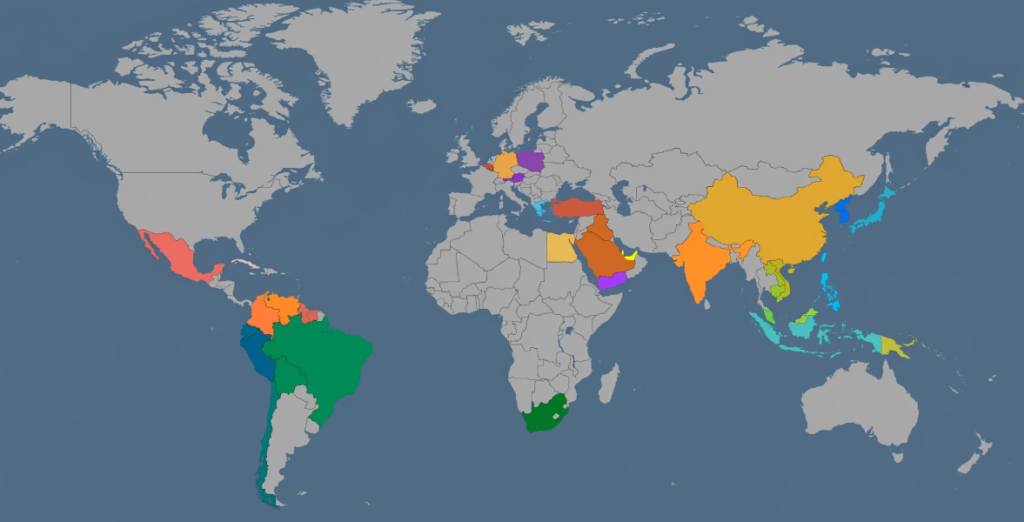
As of recent MSCI classification, the Emerging Markets Index includes 24 countries: Brazil, Chile, China, Colombia, Czech Republic, Egypt, Greece, Hungary, India, Indonesia, Kuwait, Malaysia, Mexico, Peru, Philippines, Poland, Qatar, Saudi Arabia, South Africa, South Korea, Taiwan, Thailand, Turkey, and the United Arab Emirates, spanning roughly 1,200-1,400 individual stocks.
That’s a broad geographic list — but the index’s actual composition, weighted by market capitalization, is considerably narrower than the country count suggests.
The Concentration Problem: Less Diversified Than It Looks

This is the single most important, and most commonly overlooked, fact about emerging-market index investing. Despite spanning 24 countries, the MSCI Emerging Markets Index is heavily concentrated in just a handful of them. As of recent data, Taiwan alone represents roughly a quarter of the index — driven substantially by surging AI-related demand for semiconductors — with China, South Korea, and India together making up most of the rest of the index’s largest weightings. Combined, these four countries have recently accounted for roughly 79% of the entire index’s weight, while Brazil — once considered one of the classic emerging-market growth stories — has fallen to less than 5%.
The company-level concentration is even more striking: a single company, Taiwan Semiconductor Manufacturing Company (TSMC), has recently represented more than 14% of the entire MSCI Emerging Markets Index by itself, and a majority of Taiwan’s total weight within the index traces back to that single company.
This concentration has also changed shape meaningfully over time, not just grown. A decade ago, the index’s largest single-country weight was only around 3%-4%, and the top four countries combined represented roughly 63% of the index. By the early 2020s, China alone had grown to nearly 40% of the benchmark. Today, the center of gravity has shifted again toward Taiwan and South Korea’s semiconductor and technology sectors. The practical lesson: an “emerging markets” fund is not a stable, evenly diversified basket — its composition and its dominant country exposure can shift substantially within just a few years, largely following whichever specific sector or country is driving global growth at the time.
Risks Specific to Emerging Markets
Beyond the general stock market risk covered throughout this site, emerging markets carry several risks that are either unique to the category or considerably more pronounced than in developed markets:
Currency risk. Returns from emerging-market investments are affected by fluctuations between the local currency and the U.S. dollar, in addition to the underlying stock performance itself — a currency decline can reduce your effective return even if the local stock market performed well in its own currency.
Political and geopolitical risk. Emerging-market economies are, on average, more exposed to political instability, abrupt policy changes, and geopolitical tensions than most developed markets — any of which can affect market access, company operations, or investor confidence with comparatively little warning.
Liquidity risk. Some emerging and, especially, frontier markets have less trading volume and narrower participation than developed markets, which can mean wider bid-ask spreads and more difficulty executing large trades without affecting the price.
Regulatory and governance risk. Accounting standards, shareholder protections, and market oversight can vary considerably by country, and in some cases may be less robust or less transparent than what investors are accustomed to in developed markets.
Capital controls. Some emerging-market governments have, at various points, restricted the ability of foreign investors to move money in or out of the country — a risk that doesn’t meaningfully exist in most developed markets.
Why Investors Include Emerging Markets Anyway
Despite these added risks, emerging markets remain a commonly cited component of a globally diversified portfolio, for a few widely discussed reasons:
Growth potential. Many emerging economies have historically grown faster than developed economies, driven by factors like industrialization, a growing middle class, and demographic trends — though faster economic growth doesn’t automatically translate into higher stock market returns, a distinction worth keeping in mind.
Diversification. Emerging markets don’t always move in lockstep with developed markets, meaning they can provide a genuine diversification benefit within the international portion of a portfolio, similar in concept to the correlation-based diversification logic covered in our What Is Diversification? guide.
Valuation cycles. Emerging markets have, at various points in history, traded at lower valuations relative to earnings than developed markets, which some investors interpret as a potential long-term opportunity — though, as with any valuation-based argument, lower current valuations don’t guarantee stronger future returns.
Emerging vs. Developed vs. Frontier: The Full Spectrum
Developed markets — Countries with the most mature economies, largest and most liquid stock markets, and strongest investor protections, including the U.S., Japan, the UK, and most of Western Europe.
Emerging markets — Countries with developing economies and financial markets, offering meaningful foreign investor access but not yet meeting the full criteria for developed status — the 24 countries listed earlier in this article.
Frontier markets — An even less-developed, less liquid, and generally higher-risk category than emerging markets, including countries with smaller stock markets and more limited foreign investor access. Frontier markets are covered by their own separate, smaller index category and are considerably less commonly held by mainstream index funds than broader emerging-market funds.
How to Gain Emerging-Market Exposure
Broad international funds like VXUS, covered in our VTI vs VXUS guide, already include some emerging-market exposure blended in with developed international markets. Investors specifically wanting standalone or additional emerging-market exposure can also use a dedicated emerging-markets fund, though — as covered above — it’s worth understanding exactly which index and countries a specific fund tracks, since providers like MSCI and FTSE classify individual countries (such as South Korea) differently, which can meaningfully change a fund’s actual country composition even among funds that share the “emerging markets” label.
Frequently Asked Questions
Is China the largest country in the emerging markets index? Not currently — as of recent data, Taiwan has surpassed China as the single largest country weighting in the MSCI Emerging Markets Index, driven substantially by surging global demand for Taiwanese semiconductor production. Country weightings within the index shift meaningfully over time and should be checked against current data rather than assumed.
Why do different funds have different emerging-market country exposure? Different index providers use different classification criteria and methodologies — MSCI and FTSE Russell, the two most commonly used providers, classify some countries (South Korea being a notable example) differently from each other. A fund’s actual country exposure depends on which specific index it tracks, not a single universal “emerging markets” definition.
Are emerging markets riskier than developed markets like the U.S.? Generally, yes, based on historical volatility data and the specific risk factors (currency, political, liquidity, regulatory) covered in this article. This doesn’t mean emerging markets are uninvestable — it means the added risk is a real trade-off that should be understood and deliberately sized within a broader portfolio, rather than treated the same as developed-market exposure.
Is investing in emerging markets the same as investing in “risky, small, unknown” companies? Not necessarily — the emerging-markets index includes some very large, well-established companies (TSMC being a prominent example), alongside smaller and less established ones. “Emerging market” describes a country classification, not automatically a small or unknown company classification.
How much of my international allocation should be in emerging markets? There’s no universal answer — a broad international fund like VXUS already includes emerging-market exposure blended proportionally with developed markets, based on relative market capitalization, without requiring a separate decision. Some investors choose to add dedicated emerging-market exposure beyond that blended weighting; this is a portfolio construction decision that depends on your own goals and risk tolerance, not a one-size-fits-all rule.
Can an emerging market “graduate” to developed-market status? Yes — index providers periodically review country classifications, and a country can be reclassified from emerging to developed (or from frontier to emerging) as its markets mature by the provider’s specific criteria. South Korea and Taiwan have both been the subject of ongoing discussion regarding potential reclassification, illustrating that these categories aren’t permanently fixed.
This article is provided for general informational and educational purposes only and is not a recommendation to buy or sell any security. Country classifications and index weightings referenced above reflect MSCI data as of the “last updated” date and change over time based on periodic index reviews; always verify current index composition directly with the relevant index provider or fund issuer before making an investment decision. Read our full Disclaimer and Privacy Policy for more information.
About the Author
Miguel Ángel Cibeira researches and writes every article on The Fund Atlas personally, sourcing data directly from fund issuers, the IRS, the SEC, and the Federal Reserve. He is not a licensed financial advisor, broker-dealer, or RIA — this site offers independent research and general information, not personalized financial advice. Read the full bio →