
Last updated: July 2026 · Reviewed by Miguel Cibeira
This article is for informational and educational purposes only and is not investment advice. See our full Disclaimer for details.
You’ve likely seen some version of a quote — usually attributed to Albert Einstein — calling compound interest “the eighth wonder of the world.” It’s worth clearing up before going further: there’s no verified evidence Einstein ever said this. Researchers have traced the phrase’s earliest known appearance in print to a 1983 advertisement, nearly three decades after Einstein’s death, and it’s since been widely classified as a misattribution by fact-checkers who’ve searched his published papers and archives without finding it. The quote is fictional. The underlying math, however, is entirely real — which is exactly why the phrase caught on and stuck around regardless of who actually said it.
The Basic Definition
Compound interest is interest calculated not just on your original investment (the principal), but also on the interest that investment has already earned. This is the key distinction from simple interest, which only ever calculates a return on the original principal, year after year, without factoring in previously earned interest.
Simple interest example: $10,000 earning 7% simple interest generates $700 every single year, indefinitely — after 20 years, you’ve earned $14,000 in interest, on top of your original $10,000.
Compound interest example: $10,000 earning 7% compound interest generates $700 in year one, but in year two, that 7% is calculated on $10,700, not $10,000 — generating $749. In year three, it’s calculated on $11,449, and so on. After 20 years, that same $10,000 grows to roughly $38,700 — nearly triple the simple-interest outcome, purely because each year’s growth builds on top of the previous year’s growth rather than restarting from the original amount.
Source: U.S. Securities and Exchange Commission, Investor.gov Compound Interest Calculator (official tool and explanation).
The “Hockey Stick” Effect
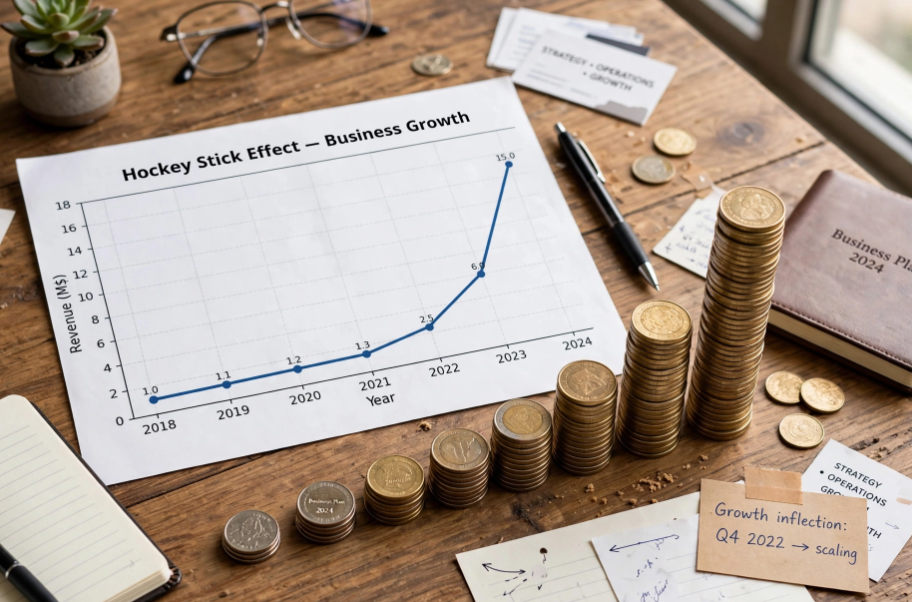
This is the part that consistently surprises people, even those who understand the concept abstractly: compound growth looks unremarkable for a long stretch, then accelerates dramatically. Using the example above, growing from $10,000 to roughly $19,700 (doubling) takes about 10 years at a 7% return. But growing from there to nearly $38,700 (doubling again) takes the same 10 years — the absolute dollar growth in the second decade is dramatically larger than in the first, even though the percentage return and time period are identical.
This pattern — modest, easy-to-dismiss growth early on, followed by a sharply accelerating curve later — is why the effect is sometimes described as a “hockey stick”: a long, flat-looking handle followed by a steep upward blade. It’s also why long-term investing advice, including our Best ETFs to Hold Long Term guide, emphasizes consistency and patience over the full multi-decade period, rather than expecting dramatic results in the early years.
A Quick Mental Math Tool: The Rule of 72
You don’t need a calculator to get a rough sense of how compounding will play out — a simple shortcut called the Rule of 72 estimates how many years it takes an investment to double at a given annual return: divide 72 by the annual return percentage.
- At 6% annual return: 72 ÷ 6 = 12 years to double
- At 8% annual return: 72 ÷ 8 = 9 years to double
- At 10% annual return: 72 ÷ 10 = 7.2 years to double
This is an approximation, not an exact calculation, but it’s accurate enough for quick, practical comparisons — and it illustrates directly how even a modest difference in annual return meaningfully changes how quickly an investment doubles.
Why Starting Early Matters More Than the Amount You Start With
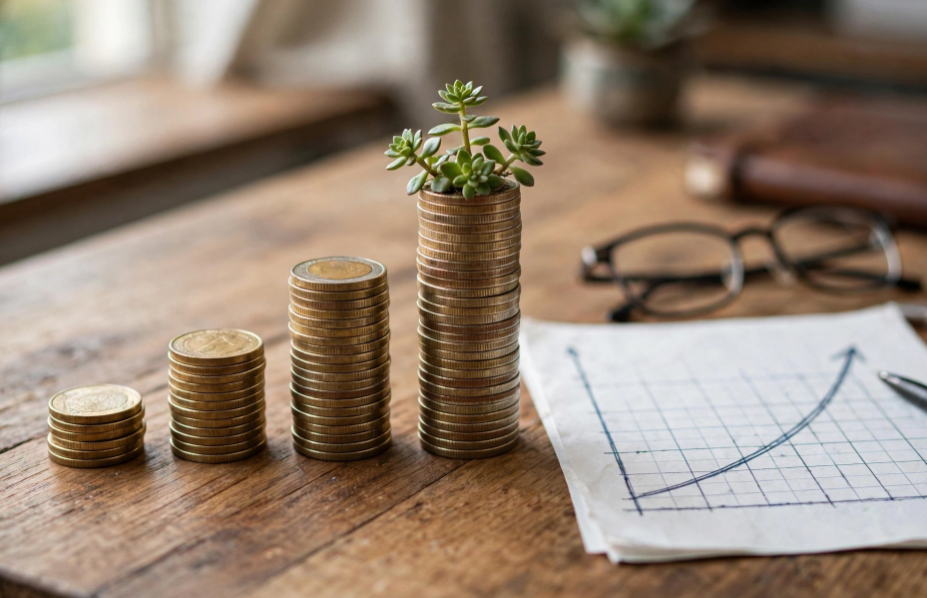
This is arguably the single most important practical implication of compounding for a long-term investor, and it’s worth illustrating with a direct comparison. Consider two hypothetical investors, both earning a 7% average annual return:
Investor A invests $5,000 per year starting at age 25 and stops entirely at age 35 (10 years of contributions, $50,000 total invested), then leaves the money untouched until age 65.
Investor B waits until age 35 to start, then invests $5,000 per year every year until age 65 (30 years of contributions, $150,000 total invested).
Despite investing three times as much money in total, Investor B, who started later, ends up with a smaller balance at age 65 than Investor A, who started ten years earlier and stopped contributing decades before retirement. The extra decade of compounding time for Investor A’s earlier contributions outweighs Investor B’s much larger total contribution amount.
This is a simplified, illustrative example using a constant hypothetical return for comparison purposes — actual investment returns vary significantly year to year and are never smooth or guaranteed.
This is the mathematical basis for the common advice to start investing as early as possible, even with small amounts, rather than waiting until you can invest a larger sum — a theme also covered in our Best ETFs for Beginners guide.
Compounding Shows Up in Multiple Places in Investing
Reinvested dividends. As covered in our What Is a Dividend? guide, automatically reinvesting dividend payments (through a DRIP) allows each payment to purchase additional shares, which then generate their own future dividends — a direct application of compound growth to a dividend-paying portfolio.
Fund expense ratios — compounding working against you. As covered in detail in our What Is an Expense Ratio? guide, fees are deducted every single year and reduce the base amount that then compounds forward — meaning a seemingly small annual fee difference compounds into a substantial gap over a multi-decade holding period, working in the opposite direction of the growth examples above.
Debt. Compounding isn’t exclusive to investment growth — credit card balances and other forms of debt that charge compound interest can grow just as dramatically against you if left unpaid, which is part of why financial guidance often prioritizes paying down high-interest debt before or alongside investing.
Why Compounding Rewards Patience Over Timing
Because compounding’s most dramatic effects show up in the later years of a long holding period, interrupting that process — by selling investments and later buying back in, or by frequently moving money in and out of the market — can meaningfully reduce the benefit of compounding, even if the timing decisions themselves don’t lose money directly. Every reset effectively restarts part of the compounding clock. This is part of the broader case, covered in our Best ETFs to Hold Long Term guide, for staying invested consistently through market volatility rather than moving in and out based on short-term conditions.
Compounding Frequency: Does It Matter How Often Interest Is Calculated?
Interest (or investment growth) can technically compound at different intervals — annually, quarterly, monthly, or even daily — and more frequent compounding does produce a slightly higher effective return, all else equal, since each compounding period adds a bit more growth for the next period to build on. In practice, for most long-term stock and fund investing, this distinction matters far less than the two factors already covered in this article: the underlying rate of return and the length of time invested. A dividend ETF paying quarterly versus monthly, for example, produces a meaningfully smaller difference in long-term outcomes than the difference between starting to invest five years earlier or later, or between a 0.05% and a 0.75% expense ratio compounding over decades.
This is a useful detail to know so that marketing language emphasizing “daily compounding” or similar phrasing doesn’t get overweighted relative to the factors that actually drive most of a long-term investor’s outcome: consistent contributions, time in the market, and minimizing unnecessary costs.
Frequently Asked Questions
Did Einstein actually call compound interest the eighth wonder of the world? No verified evidence supports this — researchers have found no record of Einstein saying or writing this in his published papers, letters, or the comprehensive Einstein Archives. The quote’s earliest known appearance in print dates to a 1983 advertisement, well after Einstein’s death in 1955. The mathematical concept it describes is accurate; the attribution to Einstein specifically is not.
How is compound interest different from a compound annual growth rate (CAGR)? They describe closely related ideas. Compound interest specifically refers to interest earning interest over time. CAGR is a way of expressing an investment’s growth over a period as a smoothed, constant annual rate — useful for comparing investments, even though actual year-to-year returns are rarely as smooth as a CAGR figure implies.
Does compounding apply to stock investments, or only interest-bearing accounts like savings accounts? It applies broadly. While the term originated with interest-bearing debt instruments, the same mathematical principle — growth building on top of previous growth — applies to reinvested stock dividends and to a portfolio’s overall growth over time, even though stock returns are far less smooth and predictable than a fixed interest rate.
How long does compounding take to become noticeable? Based on common illustrations of the effect, the growth curve typically becomes noticeably steeper after roughly 10-15 years, and dramatically so after 20-30 years — which is part of why long-term, buy-and-hold investing horizons are so frequently emphasized throughout mainstream financial guidance, including this site’s own coverage.
Can compounding work against me? Yes — this is a critical, often overlooked point. High-interest debt (like credit card balances) compounds against you in exactly the same mathematical way investment returns compound in your favor. Similarly, as covered in our What Is an Expense Ratio? guide, ongoing fund fees compound against your returns over time, which is why minimizing unnecessary costs matters more the longer you hold an investment.
Is a small amount of money worth investing early if compounding takes decades to show dramatic results? Based on the mechanics covered in this article, yes — the specific example above (an investor who stopped contributing after just 10 years but started earlier ending up ahead of one who contributed three times as much starting later) illustrates why starting early, even with modest amounts, is generally emphasized over waiting to invest a larger sum later.
This article is provided for general informational and educational purposes only and is not a recommendation to buy or sell any security. Numerical examples referenced above are simplified illustrations using constant hypothetical returns for educational comparison purposes only — they do not represent actual or projected investment performance, which varies significantly and is never guaranteed. Read our full Disclaimer and Privacy Policy for more information.
About the Author
Miguel Ángel Cibeira researches and writes every article on The Fund Atlas personally, sourcing data directly from fund issuers, the IRS, the SEC, and the Federal Reserve. He is not a licensed financial advisor, broker-dealer, or RIA — this site offers independent research and general information, not personalized financial advice. Read the full bio →