
Last updated: July 2026 · Reviewed by Miguel Cibeira
This article is for informational purposes only and is not investment advice. See our full Disclaimer for details.

If you’re new to investing, the sheer number of ETFs on the market — roughly 4,500 U.S.-listed funds as of 2026 — can make getting started feel harder than it needs to be. The good news: you don’t need to evaluate all 4,500. For most beginners, a small handful of broad, low-cost funds cover the vast majority of what you actually need.
This guide isn’t about finding the single “best” fund — it’s about understanding a few simple, well-established options and the reasoning behind them, so you can make your own informed decision rather than just copying a ticker symbol from a list.
Haven’t read our What Is an ETF? guide yet? Start there if you want the full mechanics behind how these funds actually work before diving into specific picks.
Start With the Concept, Not the Ticker
Before naming specific funds, it helps to understand what you’re actually trying to accomplish as a beginner:
- Diversification — Spreading your money across many companies instead of betting on one or two, so no single company’s bad year sinks your entire investment.
- Low cost — Keeping fees minimal, since every dollar paid in fees is a dollar not compounding for you over time.
- Simplicity — A strategy you’ll actually stick with, rather than something so complicated you abandon it after a rough month.
Almost every fund recommendation in this article traces back to one or more of these three principles. If you remember nothing else from this guide, remember this: a boring, diversified, low-cost fund that you hold consistently for decades will outperform a complicated strategy you don’t understand and eventually abandon.
Quick Comparison: Beginner-Friendly Fund Options
| ETF | What it is | Expense Ratio | Why beginners consider it |
|---|---|---|---|
| VTI | Total U.S. stock market | 0.03% | Broadest possible single-fund U.S. exposure |
| VOO | S&P 500 (large-cap U.S.) | 0.03% | Simple, widely recognized benchmark |
| VXUS | International stocks | 0.05% | Adds diversification outside the U.S. |
| BND | U.S. bond market | 0.03% | Reduces volatility, adds stability |
| SCHD | U.S. dividend stocks | 0.06% | Introduces income-focused investing |
Figures are approximate and change over time. Always confirm current expense ratios and fund details on the issuer’s official page before investing.
1. A Single Total-Market Fund (VTI or VOO)
For a genuinely simple starting point, many beginners choose one broad fund and build from there. VTI (total U.S. stock market) or VOO (S&P 500) are the two most commonly recommended starting points, for the same reasons: extremely low cost (0.03% each), broad diversification across hundreds or thousands of companies, and decades of track record as core building blocks for millions of investor portfolios.
The difference between the two is modest — VOO holds roughly 500 large companies, while VTI holds several thousand companies of all sizes, though the overlap between them is substantial since large-cap companies dominate both funds’ weighting. We go deeper on that comparison in our VOO vs VTI article, but for a true beginner, either is a reasonable place to start, and the decision between them matters far less than simply starting.
The beginner logic: One fund, one decision, broad diversification, minimal ongoing maintenance.
2. Adding International Exposure (VXUS)
Once you’re comfortable with a core U.S. fund, some beginners choose to add an international fund like VXUS, which holds thousands of stocks across developed and emerging markets outside the U.S. This isn’t mandatory — plenty of long-term investors hold U.S.-only portfolios — but it’s a common next step for those wanting geographic diversification beyond a single country’s market.
The beginner logic: Reduces reliance on any single country’s economy continuing to outperform, in exchange for a small amount of added complexity (a second fund to track and rebalance against the first).
3. Adding Stability With Bonds (BND)
Stocks — even diversified ones like VTI or VOO — can decline significantly during a downturn. Bond funds like BND generally move differently than stocks, which is why many investors add a bond allocation as a way to reduce overall portfolio volatility, particularly as they get closer to needing the money.
For a beginner with a long time horizon (think decades until retirement), a large bond allocation usually isn’t necessary yet, since the primary goal at that stage is typically long-term growth rather than capital preservation. But understanding what BND does — and that it exists as an option — matters even if you don’t use it immediately.
The beginner logic: Not essential on day one for a young, long-term investor, but useful to understand as your timeline shortens or your risk tolerance becomes clearer.
4. Understanding Dividend Investing (SCHD)
Some beginners are specifically drawn to dividend investing — the idea of owning companies that pay you a regular cash distribution just for holding their stock. SCHD, which screens for financially stable companies with a history of consistent dividends, is one of the most commonly cited starting points for this approach. We cover SCHD and other dividend options in more depth in our Best Dividend ETFs guide.
The beginner logic: A reasonable complement to a core index fund for those who specifically want an income-generating component, though it isn’t a requirement — a broad fund like VTI or VOO already includes dividend-paying companies as part of its total return.
A Simple Example Portfolio (For Illustration Only)
The following is a hypothetical example meant to illustrate how the pieces above might fit together — not a personalized recommendation for your specific situation:
| Fund | Illustrative allocation |
|---|---|
| VTI (U.S. total market) | 70% |
| VXUS (International) | 20% |
| BND (Bonds) | 10% |
A younger investor with a long time horizon and higher risk tolerance might use a smaller bond allocation than this example; someone closer to needing the money might use more. There’s no single “correct” starting allocation that applies to everyone — it depends on your timeline, goals, and comfort with short-term volatility.
Common Beginner Mistakes Worth Avoiding
Waiting for the “right” time to start. Trying to time the market perfectly is difficult even for professional investors, and the cost of waiting on the sidelines is often larger than the cost of starting slightly before a downturn. Many long-term investors find that consistent, regular investing — sometimes called dollar-cost averaging — matters more than perfect timing.
Chasing last year’s best-performing fund. A fund that performed exceptionally well last year isn’t guaranteed to repeat that performance, and chasing recent winners can lead to buying into a sector or theme right as it’s cooling off.
Overcomplicating the portfolio too early. Owning ten overlapping funds doesn’t necessarily provide more diversification than owning two or three broad ones — it often just adds complexity and makes rebalancing harder, without a meaningful benefit.
Ignoring fees because they look small. A 0.03% expense ratio and a 0.75% expense ratio might both look negligible on a monthly statement, but compounded over decades, that gap can meaningfully affect your final balance.
Reacting emotionally to short-term drops. Broad market downturns are a normal, recurring part of investing, not a sign that something has gone wrong with your strategy. Selling during a downturn locks in the loss; staying invested through it is what allows diversified funds to benefit from the market’s long-term recovery pattern.
Not knowing what account to use. Where you hold your ETFs — a taxable brokerage account, a Roth IRA, or a traditional IRA — affects your taxes as much as which fund you choose. Our Best ETFs for a Roth IRA guide covers how account type interacts with fund selection.
How to Actually Get Started
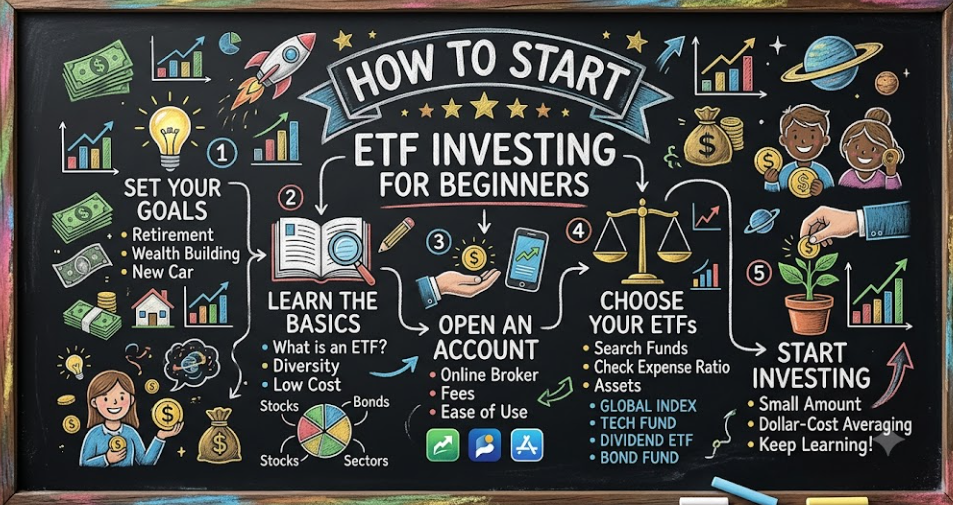
- Choose a brokerage. Most major U.S. brokers now offer commission-free ETF trading and fractional shares.
- Decide on an account type — a taxable brokerage account for flexibility, or a tax-advantaged account like a Roth IRA if you’re investing for retirement specifically and meet the income requirements.
- Fund the account with an amount you’re comfortable investing, even if it’s small.
- Choose one or two broad, low-cost funds rather than trying to build a complex portfolio on day one.
- Set up automatic, recurring contributions if your broker supports it, so investing becomes a habit rather than a decision you have to remember to make.
- Leave it alone. For a long-term, diversified strategy, frequent trading tends to hurt more than it helps.
This is a general outline of the mechanical steps involved, not a recommendation of which specific broker, fund, or account type fits your situation — that depends on your own financial circumstances and goals.
Frequently Asked Questions
How much money do I need to start investing in ETFs? Many brokers now support fractional shares and commission-free trading, meaning you can start with a small amount — sometimes as little as $1, depending on the platform. The specific dollar amount matters far less than starting consistently.
Is it safe for a beginner to invest in ETFs? Broad, diversified ETFs like VTI or VOO are generally considered a more conservative entry point than picking individual stocks, since your money is spread across many companies rather than concentrated in one. That said, all stock market investing carries risk, including the possibility of loss — there’s no such thing as a fully “safe” investment that also offers growth potential.
Should a beginner pick individual stocks or ETFs? Most beginner-focused guidance leans toward starting with diversified ETFs rather than individual stocks, simply because picking individual winners consistently is difficult even for professional investors, and a single company’s setback can significantly affect a concentrated portfolio in a way it won’t affect a diversified fund.
How many ETFs should a beginner own? There’s no universal number, but many beginners start with just one or two broad funds rather than trying to build a complex, many-fund portfolio right away. You can always add funds later as your understanding and goals develop.
What’s the biggest mistake beginners make with ETFs? Based on common investor behavior patterns, two of the most frequently cited mistakes are reacting emotionally to short-term market drops (selling at a loss during a downturn) and chasing recently high-performing funds or sectors rather than sticking with a diversified, long-term strategy.
Do I need to actively manage my ETF portfolio once I start? For a simple, broad-based strategy, ongoing “management” is usually limited to periodic contributions and occasional rebalancing — not frequent trading or constant monitoring. Many long-term investors deliberately keep their approach simple and largely hands-off.
This article is provided for general informational and educational purposes only and is not a recommendation to buy or sell any security. Expense ratios and fund details referenced above are approximate and subject to change — always verify current data directly on each issuer’s official fund page. Always do your own research and consult a licensed financial advisor before making investment decisions. Read our full Disclaimer and Privacy Policy for more information.
About the Author
Miguel Ángel Cibeira researches and writes every article on The Fund Atlas personally, sourcing data directly from fund issuers, the IRS, the SEC, and the Federal Reserve. He is not a licensed financial advisor, broker-dealer, or RIA — this site offers independent research and general information, not personalized financial advice. Read the full bio →