
Last updated: July 2026 · Reviewed by Miguel Cibeira
This article is for informational purposes only and is not investment advice. Cryptocurrency is a highly volatile asset class, and this article is not a recommendation to buy, sell, or hold any crypto ETF. See our full Disclaimer for details.
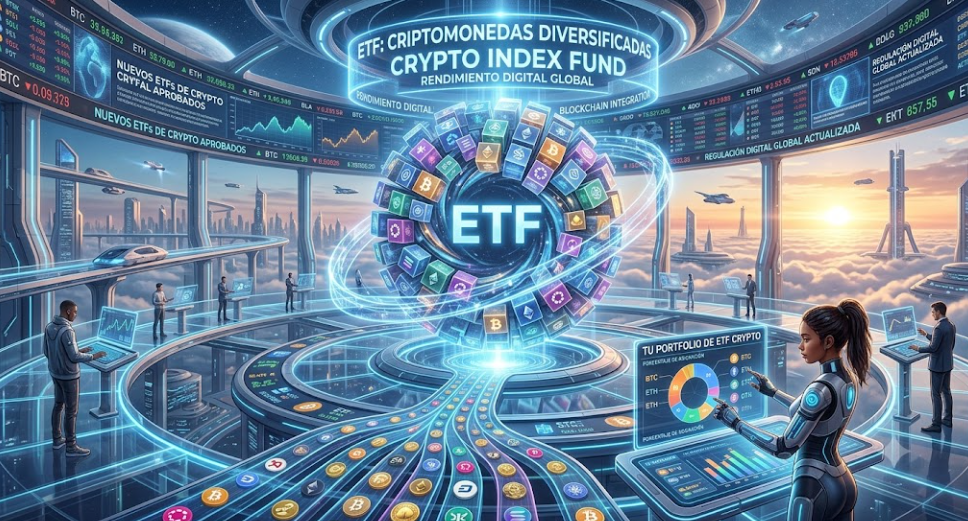
Before 2024, getting exposure to Bitcoin generally meant setting up an account on a crypto exchange, managing a digital wallet, and taking on the technical responsibility of keeping it secure. Spot crypto ETFs changed that. Today, you can buy exposure to Bitcoin, Ethereum, and a handful of other digital assets through a regular brokerage account, using the same order screen you’d use to buy VOO or SCHD.
That convenience doesn’t make crypto any less volatile — it just changes how you access it. This guide explains how crypto ETFs actually work, walks through the major Bitcoin and Ethereum funds on the market, and covers the risks that are specific to this fund category and don’t apply to a broad stock or bond ETF.
New to ETFs generally? Our What Is an ETF? guide covers the basics first. For our take on the single largest Bitcoin ETF specifically, see Best Bitcoin ETFs 2026.
How Crypto ETFs Actually Work
Spot vs. futures-based. This is the single most important distinction in this category. A “spot” crypto ETF holds the actual underlying cryptocurrency in custody and aims to track its real-time price directly. A “futures-based” crypto ETF instead holds futures contracts tied to the cryptocurrency’s price — an older structure that predates spot ETF approval in the U.S. Futures-based funds can experience “contango” costs, where the price of rolling futures contracts forward creates a persistent drag on returns relative to the actual spot price, sometimes costing several percentage points a year. For long-term holding, spot ETFs are generally preferred over futures-based alternatives for this reason.
Custody. Spot crypto ETFs hold real Bitcoin or Ethereum on behalf of shareholders, typically through a licensed digital asset custodian. Some issuers (like Fidelity) use their own in-house custody arrangement, while others rely on third-party custodians such as Coinbase Custody. This is a meaningful structural difference between funds that otherwise look similar on the surface.
No staking rewards (for Ethereum funds). Ethereum’s network allows direct holders to “stake” their ETH and earn a yield, typically in the range of 3%-4% annually. Most Ethereum ETFs available in the U.S. do not participate in staking, meaning fund holders get price exposure to Ethereum but miss out on that native yield — a meaningful difference from holding ETH directly through a wallet that supports staking.
Trading and access. Once created, crypto ETF shares trade on a regular stock exchange during normal market hours, unlike the cryptocurrency market itself, which trades 24/7. That means a crypto ETF’s price only updates and trades during standard trading hours, even though the underlying asset’s price continues moving around the clock — a gap that can produce a price jump at the next market open if something significant happened in crypto markets overnight or over a weekend.
Quick Comparison: Major Bitcoin ETFs
| ETF | Issuer | Approx. Expense Ratio | Approx. AUM | Custody |
|---|---|---|---|---|
| IBIT | BlackRock (iShares) | ~0.25% | ~$55B+ | Coinbase Custody |
| FBTC | Fidelity | ~0.25% | ~$18B | Fidelity Digital Assets (in-house) |
| ARKB | ARK Invest / 21Shares | ~0.21% | ~$2.5B | Coinbase Custody |
| BITB | Bitwise | ~0.20% | Multi-billion | Coinbase Custody |
| BTC (Mini Trust) | Grayscale | ~0.15% | ~$3.7B | Coinbase Custody |
| GBTC | Grayscale | ~1.5% (legacy, higher fee) | Multi-billion, declining | Coinbase Custody |
Figures are approximate, sourced from public ETF data providers, and change frequently — crypto ETF fees and AUM in particular can shift quickly as issuers compete on price. Always confirm current figures on each issuer’s official fund page before investing.
Bitcoin ETFs: The Major Players
iShares Bitcoin Trust (IBIT) is the largest and most heavily traded spot Bitcoin ETF by a wide margin, backed by BlackRock, the world’s largest asset manager. Its scale translates into the deepest liquidity and the most developed options market among Bitcoin ETFs, which matters most for active traders and large institutional allocations. Its custody is handled through Coinbase.
Fidelity Wise Origin Bitcoin Fund (FBTC) is the strongest alternative to IBIT by assets, and it holds one structural distinction worth knowing: Fidelity self-custodies the Bitcoin backing the fund through its own Fidelity Digital Assets division, rather than relying on Coinbase as many competing funds do. For investors who specifically want custody diversification away from the Coinbase ecosystem that underpins most other major Bitcoin ETFs, FBTC is the primary alternative.
Grayscale Bitcoin Mini Trust (BTC) consistently carries one of the lowest expense ratios among major spot Bitcoin ETFs. For a long-term, buy-and-hold investor prioritizing minimizing ongoing costs over trading liquidity, this fee difference compounds over time, even though the dollar amount looks small year to year.
ARK 21Shares Bitcoin ETF (ARKB) and Bitwise Bitcoin ETF (BITB) both offer competitive fees in a similar range to the Grayscale Mini Trust, with smaller asset bases than IBIT or FBTC but sufficient scale and liquidity for most individual investors.
Grayscale Bitcoin Trust (GBTC) was the original vehicle many institutional investors used for Bitcoin exposure before spot ETF conversion, and it still holds substantial legacy assets. Its expense ratio, however, is dramatically higher than every other fund on this list — a legacy structure that has driven significant investor outflows toward cheaper alternatives since spot ETFs launched.
Ethereum ETFs
BlackRock’s iShares Ethereum Trust (ETHA) functions as Ethereum’s equivalent to IBIT — the liquidity leader among spot Ethereum ETFs, with strong institutional backing and tracking accuracy. As noted above, it does not currently offer staking rewards, meaning it captures Ethereum’s price movement but not the network’s native staking yield.
Fidelity Ethereum Fund (FETH) mirrors FBTC’s positioning within the Bitcoin category — Fidelity’s own entry, with in-house custody through Fidelity Digital Assets rather than a third-party custodian.
Ethereum ETFs are structurally similar to Bitcoin ETFs in most respects, but it’s worth remembering that Bitcoin and Ethereum are different assets with different use cases, adoption drivers, and volatility profiles — a fund tracking one is not a substitute for exposure to the other.
Multi-Crypto and Index-Style Funds
For investors who don’t want to choose between individual cryptocurrencies, a small number of funds — such as Grayscale’s GDLC, which tracks a basket of major cryptocurrencies via the CoinDesk 5 Index — offer diversified exposure across several digital assets in a single fund, generally at a meaningfully higher expense ratio (in GDLC’s case, around 0.59%) than a single-asset Bitcoin or Ethereum ETF.
Worth knowing: “Diversification” within crypto still means diversification across a single, highly correlated asset class. Owning a basket of five cryptocurrencies reduces single-asset risk somewhat, but it doesn’t provide the kind of diversification benefit you’d get from combining crypto with an entirely different asset class like stocks or bonds — crypto assets have historically tended to move in the same direction as each other during major market swings, more so than, say, a technology stock and a utility stock would.
Risks That Are Specific to Crypto ETFs
Every ETF carries market risk, but crypto ETFs carry several risks that don’t apply, or apply very differently, to a broad stock or bond fund:
- Extreme volatility. Bitcoin and other cryptocurrencies have a well-documented history of 50% or larger price drawdowns, sometimes within a matter of months. The ETF wrapper provides regulatory protection and custody convenience — it does not reduce the underlying asset’s volatility.
- No dividend or yield. Unlike a dividend or bond fund, crypto ETFs generate no income at all — your only potential return comes from the price of the underlying asset appreciating.
- No staking yield on most Ethereum funds, as noted above — a specific, often-overlooked gap versus holding ETH directly.
- Regulatory risk. Cryptocurrency regulation continues to evolve, and changes in U.S. or global regulatory treatment could materially affect these funds, their custodians, or the underlying assets they hold.
- Custody and counterparty risk. While spot ETFs are considered more secure than self-custodying crypto directly, you’re still relying on the fund’s custodian (Coinbase, Fidelity Digital Assets, or others) to safely hold the underlying assets.
- Concentration risk in single-asset funds. A Bitcoin-only or Ethereum-only ETF offers no diversification beyond that single cryptocurrency — a downturn specific to that asset affects the entire fund.
- Market-hours mismatch. As mentioned above, crypto trades 24/7 while the ETF only trades during stock market hours, which can create price gaps at the market open following significant overnight moves.
Because of this risk profile, most financial commentary on this fund category — and this article is no exception — frames crypto ETFs as, at most, a small satellite allocation within a diversified portfolio, not a core holding.
Crypto ETFs vs. Holding Crypto Directly
| Factor | Crypto ETF | Direct crypto ownership |
|---|---|---|
| Custody responsibility | Handled by the fund’s custodian | You manage your own wallet/security |
| Account compatibility | Works in standard brokerage, IRA, 401(k) accounts | Requires a separate crypto exchange/wallet |
| Trading hours | Standard stock market hours | 24/7 |
| Staking yield (Ethereum) | Generally not available in most current U.S. ETFs | Available if self-custodied and staked |
| Regulatory oversight | SEC-registered security | Varies by exchange/jurisdiction |
| Ongoing cost | Annual expense ratio | Exchange fees, no ongoing expense ratio |
Neither approach is universally “better” — a crypto ETF trades some flexibility and yield potential (staking) for regulatory oversight, custody convenience, and compatibility with standard retirement accounts.
Tax Treatment and Account Considerations
Spot crypto ETFs are SEC-registered securities, which means they’re generally taxed similarly to other ETFs — you owe capital gains tax when you sell shares at a profit, with the rate depending on your holding period (short-term vs. long-term) and income level. Because these ETFs are classified as securities, the IRS wash-sale rule can apply to them, meaning selling a crypto ETF at a loss and buying back the same fund within 30 days may disallow the loss for tax purposes — a rule that, at least for now, is generally understood to work differently for direct cryptocurrency holdings, which the IRS has historically treated as property rather than a security. This is a genuinely complex and evolving area of tax law; a tax professional should confirm current treatment for your specific situation.
On the account side, spot crypto ETFs are generally eligible to be held in standard brokerage accounts as well as tax-advantaged retirement accounts like a Roth IRA, traditional IRA, or 401(k) — provided your specific plan or brokerage supports ETF trading. That’s a meaningful structural advantage over direct crypto ownership, which typically requires a separate crypto exchange account outside a standard retirement account structure. We cover account-specific fund selection more broadly in our Best ETFs for a Roth IRA guide.
Volatility Risk Isn’t Unique to Crypto
Crypto ETFs are the most volatile category covered on this site, but they’re not the only volatile ETFs on the market — and understanding the broader pattern helps put crypto-specific risk in context.
Leveraged and inverse ETFs amplify daily index moves (2x or 3x), and are structurally designed for short-term trading rather than long-term holding — due to how daily rebalancing compounds over time, they can behave in ways that surprise investors who hold them for extended periods, even if the underlying index eventually moves in the direction they expected.
Single-sector and thematic ETFs — funds concentrated in one industry (say, biotech, uranium, or a narrow “innovation” theme) — carry more concentration risk than a broad index fund, since there’s no diversification cushion if that specific sector or theme falls out of favor.
Newly launched or thinly traded ETFs, regardless of what they hold, can carry added liquidity risk: wider bid-ask spreads, less predictable pricing, and in some cases, a higher chance the fund closes down if it doesn’t attract enough investor assets over time.
What connects all of these categories, including crypto ETFs, is concentration — the less diversified a fund is, and the more specialized or amplified its strategy, the more its price can swing in either direction relative to a broad, diversified core holding like VOO or VTI. None of that makes these funds inherently “bad” investments — it means they carry a different risk profile that deserves a correspondingly different level of scrutiny and portfolio sizing before you buy.
Why Research Matters Before You Invest in Any ETF — Especially a Volatile One
This site exists specifically because “best ETF” content often skips past the due-diligence step in favor of a quick ticker list. Before putting money into any ETF — and especially a higher-volatility one like a crypto, leveraged, or narrow thematic fund — it’s worth working through a few questions:
What does the fund actually hold, and how concentrated is it? A fund’s name doesn’t always tell the full story. Check the issuer’s official fund page for the current holdings list and sector or asset breakdown, not just the ticker’s reputation.
What’s the expense ratio, and how does it compare to similar funds? As covered throughout this site, fee differences that look small in a single year compound meaningfully over a long holding period.
How liquid is the fund? Look at average daily trading volume and typical bid-ask spread. Thinly traded funds can cost you more than the expense ratio suggests once you factor in the cost of actually buying and selling.
How has the fund behaved during past downturns? Historical performance doesn’t predict future returns, but understanding a fund’s typical volatility and past drawdowns can help you gauge whether you’re actually prepared to hold through a similar decline, rather than finding out during an actual downturn that you weren’t.
How does this fund fit with what you already own? A new position doesn’t exist in isolation — check whether it duplicates exposure you already have (as we discussed with VOO and VTI, or SCHD and DGRO) or genuinely adds something different to your portfolio.
What’s the worst-case scenario you’re comfortable with? This is especially relevant for high-volatility categories like crypto or leveraged ETFs. Position-sizing a volatile holding as a small percentage of a diversified portfolio is a fundamentally different decision than concentrating a large share of your savings in it — and that sizing decision matters more than which specific fund you choose within the category.
Is this money you can afford to have tied up, or potentially reduced, for a while? Highly volatile assets are generally discussed as a poor fit for money you expect to need in the short term, given how sharply and quickly their value can move in either direction.
None of this replaces professional financial advice tailored to your specific situation — it’s a starting checklist, not a substitute for it. But going through these questions before investing, rather than after a fund has already moved sharply against you, is one of the most consistently repeated pieces of guidance across mainstream investing education, for good reason.
Who Tends to Consider Crypto ETFs
Investors who already understand and accept Bitcoin or Ethereum’s volatility and specifically want that price exposure without managing a separate crypto wallet or exchange account.
Investors who want crypto exposure inside a tax-advantaged retirement account, where direct crypto ownership typically isn’t an available option.
Investors sizing a small, defined “satellite” allocation on top of a diversified core portfolio, rather than treating crypto as a primary holding.
Crypto ETFs are generally not positioned, in the vast majority of mainstream financial commentary, as a substitute for a diversified core portfolio of stocks and bonds — they’re typically discussed as a smaller, higher-risk addition for investors who specifically want that exposure.
Frequently Asked Questions
Is a Bitcoin ETF the same as owning Bitcoin? Not exactly. A spot Bitcoin ETF holds real Bitcoin in custody and aims to track its price closely, but you own shares of the fund, not the underlying Bitcoin directly. You don’t control a private key or wallet, and you’re relying on the fund’s custodian to securely hold the actual asset.
Are crypto ETFs safer than buying crypto directly on an exchange? They reduce certain risks — you don’t have to manage your own private keys or wallet security, and the fund is a regulated, SEC-registered security. They don’t reduce the underlying volatility of the cryptocurrency itself, which remains substantial regardless of how you access it.
Why don’t Ethereum ETFs offer staking rewards? Most currently available U.S. spot Ethereum ETFs have not incorporated staking into their structure, meaning they track ETH’s price but don’t generate the additional yield available to direct holders who stake their ETH. This is a specific, evolving area — check current fund documentation for the latest structure, since this is an area regulators and issuers continue to work through.
Can I hold a crypto ETF in my Roth IRA? Generally yes, provided your brokerage supports ETF trading within your IRA — this is one of the main structural advantages crypto ETFs offer over direct cryptocurrency ownership, which typically isn’t available inside standard retirement accounts.
What’s the difference between IBIT and FBTC? Both are large, similarly priced spot Bitcoin ETFs. The most commonly cited practical difference is custody: FBTC uses Fidelity’s own in-house custody, while IBIT relies on Coinbase Custody, along with differences in trading liquidity and options market depth, where IBIT currently leads.
How much of my portfolio should be in crypto ETFs? There’s no universal answer — it depends entirely on your risk tolerance, timeline, and overall financial situation. Given the volatility profile discussed throughout this article, most mainstream financial guidance frames crypto as a smaller, higher-risk allocation rather than a core portfolio holding, but this is general information, not a personalized recommendation. A licensed financial advisor can help evaluate what, if any, allocation fits your specific circumstances.
Do crypto ETFs pay dividends? No. Crypto ETFs hold assets that don’t generate income the way dividend-paying stocks or interest-paying bonds do, so any return depends entirely on the price of the underlying cryptocurrency appreciating.
What should I check before investing in any volatile ETF, not just crypto? At minimum: what the fund actually holds and how concentrated it is, its expense ratio relative to similar funds, its trading liquidity, how it has behaved during past downturns, and how it fits with what you already own. Just as important is being honest with yourself about how much of a decline you could tolerate without needing to sell — and making sure you’re not investing money you might need on a short timeline. This checklist applies broadly, not just to crypto ETFs.
This article reflects publicly available fund data as of the “last updated” date above and is provided for informational purposes only — it is not a recommendation to buy or sell any security or cryptocurrency. Cryptocurrency and crypto ETFs are highly volatile and carry substantial risk of loss. Expense ratios, AUM, custody arrangements, and regulatory treatment referenced above change frequently; always verify current data directly on each issuer’s official fund page before making an investment decision. Read our full Disclaimer and Privacy Policy for more information.
About the Author
Miguel Ángel Cibeira researches and writes every article on The Fund Atlas personally, sourcing data directly from fund issuers, the IRS, the SEC, and the Federal Reserve. He is not a licensed financial advisor, broker-dealer, or RIA — this site offers independent research and general information, not personalized financial advice. Read the full bio →