
Last updated: July 2026 · Reviewed by Miguel Cibeira
This article is for informational and educational purposes only and is not personalized investment advice. See our full Disclaimer for details.
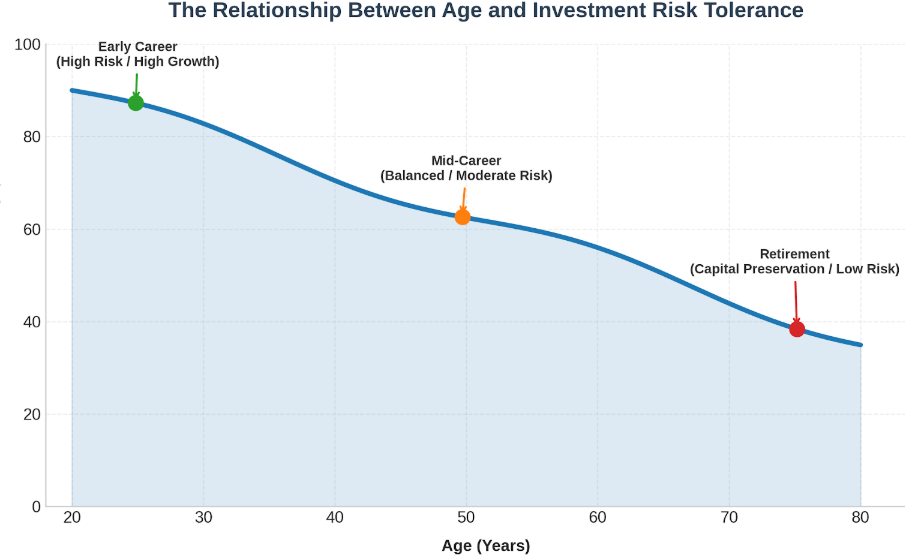
You’ve probably heard some version of this advice before: “you’re young, you can afford to take more risk.” It’s repeated so often in investing content that it can start to sound like a cliché rather than a reasoned argument. But the logic behind it is genuinely solid, and understanding why it’s true — not just that it’s true — makes it much easier to figure out where you personally fit on that spectrum, rather than blindly following a rule of thumb.
This article walks through the actual mechanics behind age-based investing: time horizon, the difference between risk tolerance and risk capacity, sequence-of-returns risk, and how target-date funds translate all of this into a concrete stock-to-bond glide path over a lifetime.
New to investing generally? Our What Is an ETF? and Best ETFs for Beginners guides cover the fundamentals first.
The Core Argument: Time Horizon Changes Everything
Stocks, as an asset class, have historically delivered stronger long-term returns than bonds or cash — but with meaningfully more short-term volatility, including periods where the market has dropped 30%-50% or more. The entire case for holding more stocks when you’re young comes down to one fact: the longer your investing time horizon, the more time you have to recover from a downturn before you actually need the money.
A 25-year-old investing for a retirement that’s 40 years away can, in theory, ride out even a severe multi-year market decline, because there’s no need to sell during the bad years — the money isn’t being withdrawn for decades. A 70-year-old already drawing income from their portfolio doesn’t have that same luxury: a sharp downturn that hits right as they’re withdrawing money can do lasting damage that a market recovery years later doesn’t fully undo, because some of the portfolio was already sold off, at depressed prices, to cover living expenses.
This is the entire logic in a nutshell. Everything else in this article is really just a more detailed explanation of that same idea.
Risk Tolerance vs. Risk Capacity: Two Different Things
These two terms get used interchangeably, but they describe different concepts, and separating them makes age-based investing much clearer.
Risk tolerance is psychological — how much portfolio volatility you can handle emotionally without panic-selling at the worst possible moment. Some 25-year-olds have low risk tolerance and lose sleep over a 10% drop. Some 65-year-olds have high risk tolerance and shrug off a 30% decline.
Risk capacity is mathematical — how much risk your actual financial situation can absorb, based on your time horizon, income stability, savings rate, and how soon you’ll need the money, regardless of how you feel about it emotionally.
Age-based investing rules of thumb are really statements about risk capacity, not risk tolerance. A young investor generally has higher risk capacity because of their long time horizon — but if their risk tolerance is much lower than their capacity, a formula-driven “maximum stocks” allocation might not actually be the right fit for them personally, since panic-selling during a downturn can do more damage than simply holding a somewhat more conservative allocation consistently. Both factors matter; a rule of thumb only accounts for one of them.
Human Capital: The “Bond” Young Investors Already Own
Here’s a concept that doesn’t get discussed enough in mainstream investing content: your future earning potential — what financial researchers sometimes call “human capital” — behaves a lot like a bond already sitting in your overall financial picture, even though it’s not something you can see on a brokerage statement.
A 25-year-old with a stable career ahead of them has decades of future paychecks to rely on — a steady, bond-like stream of “income” that isn’t directly exposed to stock market volatility. That existing bond-like asset (future earnings) is part of why many financial researchers argue a young investor’s actual investment portfolio can lean more heavily into stocks: they already have an enormous, non-market-correlated asset (their future income) providing stability in the background.
As you age, this dynamic flips. Your remaining working years — and therefore your remaining “bond-like” future income — shrink, while your investment portfolio needs to take over more of the job of funding your lifestyle. That’s a large part of the mathematical justification behind gradually shifting from stocks toward bonds as retirement approaches, independent of any change in how you personally feel about volatility.
Sequence-of-Returns Risk: Why Timing Matters More Near Retirement
This is one of the most important, and most underexplained, concepts in retirement investing.
Imagine two investors who both average the exact same return over a 30-year retirement — but one experiences a market crash in the first few years of retirement, and the other experiences that same crash in the final few years. Even with identical average returns, the investor who got hit early can end up in a meaningfully worse position, because they were forced to sell shares at depressed prices to cover living expenses early on, permanently reducing the amount of money left to benefit from the eventual recovery.
This is called sequence-of-returns risk, and it’s a big part of why the standard advice for investors nearing or in retirement isn’t just “hold more bonds because you’re older” — it’s specifically about protecting the portion of the portfolio you’ll need to draw on in the near term from a bad-timing scenario, while often still keeping a meaningful stock allocation for the money you won’t need for many more years.
What the Actual Numbers Look Like
There’s no single official formula, but there are several well-known rules of thumb, along with real-world data on what target-date retirement funds — which manage trillions of dollars using professionally designed “glide paths” — actually do in practice.
Classic rule of thumb (“100 minus your age”): Subtract your age from 100 to get your stock allocation. A 30-year-old would hold 70% stocks. This rule dates back to an era of shorter life expectancies and more common employer pensions, and many modern advisors consider it too conservative for today’s longer retirements.
Updated rules of thumb (“110” or “120 minus your age”): Increasingly common alternatives that push more of the allocation into stocks to account for longer life expectancies and the need for portfolios to keep growing through a retirement that could last 25-30+ years.
Real target-date fund glide paths: According to published fund methodology, Vanguard’s target-date funds hold around 90% stocks for investors roughly 25+ years from retirement, gradually reducing that stock allocation by a few percentage points a year, and settling around 30% stocks by the time an investor is well into retirement (roughly age 72 and beyond). Fidelity follows a broadly similar pattern, with a somewhat steeper reduction closer to retirement.
A closer look at actual investor behavior: Data compiled from sources including Vanguard’s “How America Saves” research and the Investment Company Institute suggests real-world retirement account allocations often run even more aggressive than the classic rules of thumb suggest — investors under 25 hold roughly 87% in equities on average, a figure that stays elevated through the late 30s before the glide-path-driven reduction begins in earnest, according to this research.
An Illustrative Example (Not a Recommendation)
The following is a simplified, hypothetical illustration of how a stock/bond split might shift across decades, based on common glide-path patterns — not a personalized recommendation for your specific situation:
| Age range | Illustrative stock allocation | Illustrative bond allocation |
|---|---|---|
| 20s | ~85%–90% | ~10%–15% |
| 30s | ~80%–90% | ~10%–20% |
| 40s | ~70%–80% | ~20%–30% |
| 50s | ~60%–70% | ~30%–40% |
| 60s | ~45%–60% | ~40%–55% |
| 70s and beyond | ~30%–50% | ~50%–70% |
A few things worth noting about this table: even the oldest bracket still typically holds meaningful stock exposure — not zero — because modern retirements can last 20-30+ years, and a portfolio that’s entirely bonds risks losing purchasing power to inflation over that long a stretch. On the other end, the specific numbers in the 20s and 30s rows matter less than the general shape: a long time horizon generally supports a stock-heavy allocation, with the specific percentage depending on your own risk tolerance, income stability, and goals.
Why “Playing It Safe” Can Actually Be the Riskier Move When You’re Young
This is a counterintuitive point worth sitting with: for a young investor with decades until retirement, holding too little in stocks can be a bigger risk than holding too much. A young investor who keeps their long-term retirement savings mostly in cash or bonds isn’t avoiding risk — they’re trading short-term volatility for a different risk entirely: the risk that their money doesn’t grow enough over several decades to meaningfully outpace inflation and actually fund a multi-decade retirement.
Short-term price swings feel risky because they’re visible and immediate. The risk of under-investing over a 40-year horizon is just as real, but it’s quieter and shows up later — which is exactly why it’s so often underweighted in how people intuitively think about risk.
Older Investors Still Generally Hold Some Stocks — Here’s Why
It’s a common misconception that retirement means shifting entirely out of stocks. In practice, most professionally designed glide paths — and most mainstream financial guidance — keep a meaningful stock allocation (often 30%-50%) even well into retirement. The reasoning connects back to the same core idea: with retirements now commonly lasting two to three decades, a portfolio still needs some growth engine to avoid losing purchasing power to inflation over that time, even as the priority shifts from maximum growth toward capital preservation and stable income.
A Formula Is a Starting Point, Not a Final Answer
Every rule of thumb and every target-date fund glide path in this article is a generalized model — useful for understanding the underlying logic, but not a substitute for your own specific circumstances. A few examples of factors that can reasonably shift someone away from a “textbook” age-based allocation:
- Job and income stability — A highly stable income (or a pension) can support a bit more portfolio risk; unpredictable or variable income might warrant more caution.
- Other assets and goals — Significant savings outside retirement accounts, a shorter-term goal like a house down payment, or existing debt can all change what allocation makes sense for a given pool of money.
- Genuine risk tolerance — If a 30% portfolio decline would genuinely cause you to panic-sell everything, a more conservative allocation that you can actually stick with may serve you better than a theoretically “optimal” aggressive one you’d abandon at the worst possible time.
- Health and life expectancy considerations — These can reasonably affect how someone weighs a longer versus shorter expected retirement horizon.
Frequently Asked Questions
At what age should I start reducing my stock allocation? There’s no universal age — it depends on your personal timeline, risk tolerance, and financial situation. Many target-date fund glide paths begin gradually reducing stock exposure starting somewhere in the investor’s late 30s to 40s, continuing gradually for decades rather than making a sudden shift at a single age.
Is it too risky for a 25-year-old to be 90% in stocks? For a long time horizon (multiple decades until the money is needed), many financial professionals and target-date fund providers consider a stock-heavy allocation reasonable — this reflects the time-horizon logic covered throughout this article. Whether it’s the right fit for a specific individual also depends on their personal risk tolerance and overall financial picture, which a formula alone doesn’t capture.
Should retirees avoid stocks completely? Generally not, according to most mainstream financial guidance. Even in retirement, portfolios commonly retain a meaningful stock allocation (often 30%-50%) to help combat inflation over what can be a multi-decade retirement, while shifting a larger share toward bonds to manage near-term sequence-of-returns risk.
What is sequence-of-returns risk, in simple terms? It’s the risk that comes from when, not just whether, a market downturn happens relative to when you’re withdrawing money. A downturn early in retirement, while you’re actively selling shares to cover expenses, tends to do more lasting damage than the same downturn occurring later, because the early losses are effectively locked in through the withdrawals.
Are target-date funds a good option for age-based investing? Target-date funds automate the general glide-path concept discussed in this article, gradually shifting from stocks to bonds as the target date approaches, without requiring you to manually rebalance. They’re professionally managed to a broad average, not personalized to your specific situation — some investors use them as a simple, hands-off core holding, while others prefer to build a custom allocation. This is general information, not a recommendation of any specific approach for you.
Does risk tolerance matter more than risk capacity, or vice versa? Neither fully overrides the other — they work together. A young investor might have high risk capacity (a long time horizon) but low personal risk tolerance (they panic during downturns), or the reverse. The most sustainable allocation is generally one that reasonably fits both your mathematical capacity for risk and your actual emotional ability to stay invested through a decline, since abandoning a strategy during a downturn can undo the benefit of having chosen it in the first place.
This article is provided for general informational and educational purposes only and is not personalized investment advice. Allocation examples and glide-path figures referenced above are illustrative and based on publicly available fund methodology and industry research as of the “last updated” date; they are not a recommendation for your specific portfolio. Always do your own research and consult a licensed financial advisor to determine an allocation appropriate for your individual circumstances. Read our full Disclaimer and Privacy Policy for more information.
About the Author
Miguel Ángel Cibeira researches and writes every article on The Fund Atlas personally, sourcing data directly from fund issuers, the IRS, the SEC, and the Federal Reserve. He is not a licensed financial advisor, broker-dealer, or RIA — this site offers independent research and general information, not personalized financial advice. Read the full bio →