
Last updated: September 2026 · Reviewed by Miguel Cibeira
This article is for informational purposes only and is not investment advice. See our full Disclaimer for details.
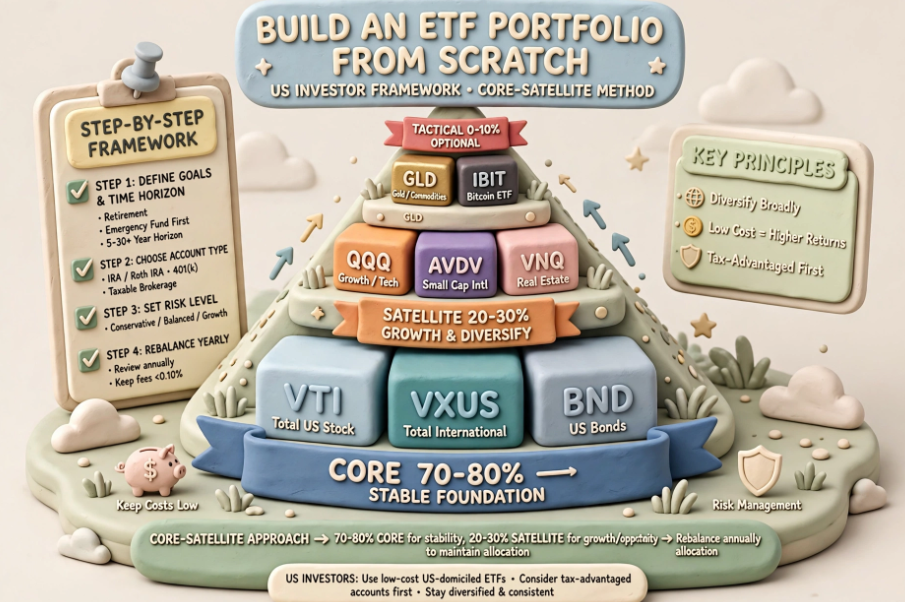
Most people who invest in ETFs don’t actually have a portfolio. They have a collection of funds they bought one at a time, usually after reading a single article about a single ticker, with no clear reason for how those pieces fit together, how much of each they should hold, or when — if ever — they’re supposed to revisit any of it. That’s not a criticism; it’s just how most people arrive at investing, article by article, decision by decision, without ever stepping back to see the whole shape of what they’re building.
This guide is the step back. It walks through the complete process of building and maintaining an ETF portfolio from the ground up — not picking a single fund, but deciding what kind of investor you actually are, where your money should legally sit, how to judge one fund against another, how to combine funds into a coherent whole, and how to keep that whole thing working for decades without babysitting it daily. Every step links to a deeper, dedicated article on this site if you want to go further, and every non-obvious claim is sourced to a primary source — the SEC, the IRS, or the fund managers themselves — rather than just asserted.
What This Guide Covers, and What It Deliberately Doesn’t
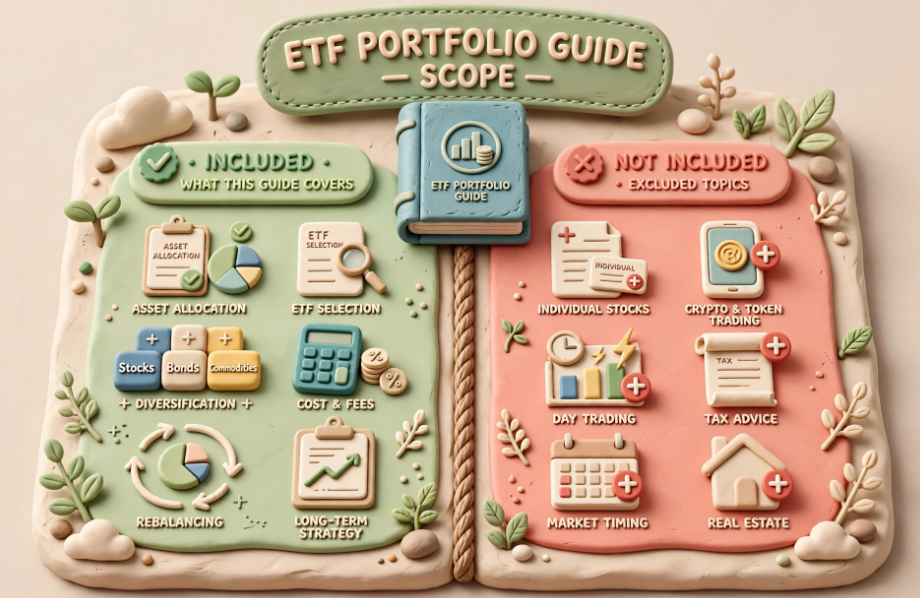
This is a process guide, not a stock-picking guide. If what you actually need is help narrowing down a single fund for a single, specific purpose, our decision guide to choosing the right ETF for your goals is the more direct resource. What follows here is the layer above that decision — the framework you’d ideally have in place before you’re staring at a list of ticker symbols trying to decide which one is “best,” because “best for what, exactly?” is a question a framework answers and a ranked list can’t.
We’re also not going to hand you a single model portfolio and tell you it’s right for you, because it almost certainly isn’t. Your time horizon, your risk tolerance, your tax situation, and your existing accounts are all specific to you, and a framework that ignores that in favor of one “set it and forget it” allocation is selling simplicity at the cost of accuracy. Instead, this guide gives you the actual decision points, in order, with the real trade-offs at each one.
Step 1: Define What You’re Actually Building This For
Every other decision in this guide flows from two questions, and skipping them is the single most common reason ETF portfolios end up incoherent: how long until you need this money, and how much short-term loss can you actually tolerate without making a panicked decision you’ll regret. The SEC’s own investor education material frames these as the two central inputs to asset allocation, noting plainly that “all investments involve some degree of risk,” and that your mix of stocks, bonds, and cash should be built around your specific time horizon and risk tolerance rather than a generic formula.[1]
Time horizon is the more objective of the two. Money you need in two years for a house down payment has almost no business being heavily allocated to stocks, no matter how much risk you say you can handle — a market downturn doesn’t care about your deadline. Money you won’t touch for thirty years can absorb far more volatility along the way, because time is what allows a portfolio to recover from a bad stretch before the money is actually needed, a dynamic covered in more depth in our guide on why younger investors can typically afford to take on more risk.
Risk tolerance is more subjective, and more often misjudged, because most people overestimate it until they actually experience a real decline. It’s worth being honest with yourself here in a specific way: not “how much of a drop could I theoretically explain to myself is fine,” but “how much of a drop, sustained for months, would actually make me sell at the worst possible time.” Our guide to common myths about market volatility goes further into how volatility, beta, and standard deviation are measured, but the honest self-assessment here is more important than the math — a portfolio you can’t emotionally hold through a real decline isn’t actually the right portfolio for you, regardless of what a risk questionnaire says on paper.
Step 2: Choose the Right Account Before You Choose a Fund
This is the step most beginner guides skip entirely, and it’s a mistake — which account holds your ETFs can matter as much as which ETFs you hold, because it changes how (and whether) you’re taxed on the returns. The three account types most U.S. investors are choosing between are a traditional IRA or 401(k), a Roth IRA or Roth 401(k), and a standard taxable brokerage account, and each treats the same fund completely differently.
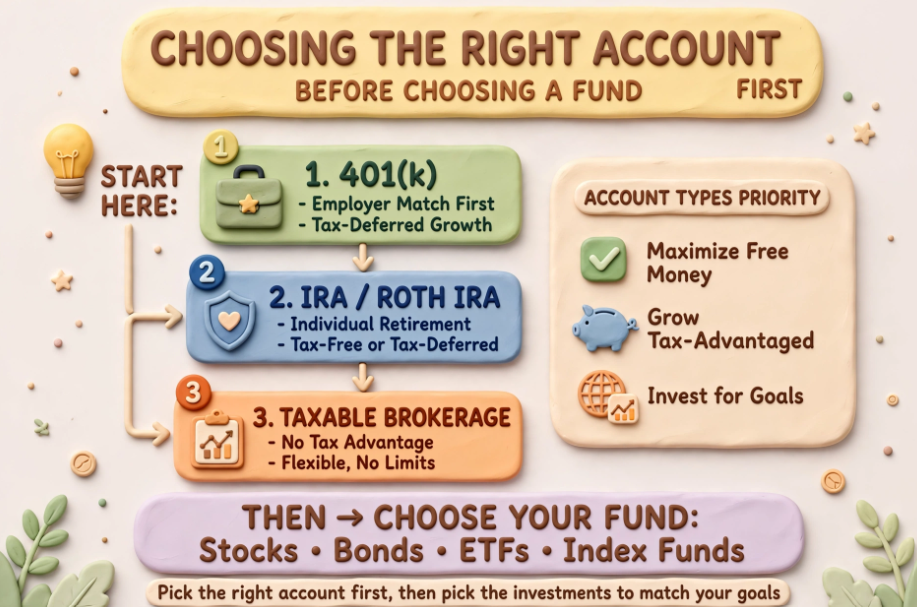
According to IRS Publication 590-A, the core distinction between a traditional and a Roth IRA comes down to when you pay tax. A traditional IRA’s contributions “may be fully or partially deductible” up front, but “amounts in your IRA (including earnings and gains) aren’t taxed until distributed” — you defer the tax bill to retirement. A Roth IRA works in reverse: “you can never deduct contributions to a Roth IRA,” but qualified withdrawals in retirement, including all the growth, come out completely tax-free.[3] Roth eligibility also phases out at higher incomes, so it isn’t available to everyone without a workaround. Our dedicated guides on 401(k) accounts and on choosing ETFs specifically for a Roth IRA go deeper into each account individually.
A taxable brokerage account has none of those restrictions or advantages — no contribution limits, no income phase-outs, no penalty for withdrawing early — but you’ll owe tax on dividends every year they’re paid and on any capital gains when you eventually sell. That makes fund selection genuinely different in a taxable account: a fund that trades frequently inside itself or distributes large capital gains can quietly cost you more in a taxable account than the exact same fund would in an IRA, which is the core idea behind our guide on tax-efficient fund selection for taxable accounts. A related tool worth understanding once you’re investing across more than one account type is tax-loss harvesting, which only applies in a taxable account and can meaningfully offset other gains.
The practical takeaway: if you have access to a Roth account and expect to be in a similar or higher tax bracket in retirement, growth-heavy holdings often make the most sense there, since all of that growth eventually comes out tax-free. Slower-growing, income-generating holdings are often better suited to a traditional account or a taxable account, where the tax treatment is less costly. This is a general pattern, not a rule — your specific tax bracket, income trajectory, and account access all change the calculation, which is exactly why this step comes before fund selection, not after.
Step 3: Learn to Actually Evaluate One ETF Against Another
Once you know your time horizon, risk tolerance, and account, you’re finally ready to evaluate individual funds — and most people evaluate them on the wrong criteria. Past performance is the number everyone looks at first, and it’s the least useful one, because it says nothing reliable about the future and everything about a period that’s already over. Four criteria matter far more in practice.
Expense ratio is the annual fee, expressed as a percentage of your investment, and it compounds against you every single year you hold the fund. The gap between a 0.03% fund and a 0.40% fund sounds trivial until you run it over decades — our expense ratio cost calculator lets you see the actual dollar impact on your own numbers. According to the Investment Company Institute, the asset-weighted average expense ratio for index equity ETFs was around 0.14% in 2025, while actively managed equity mutual funds averaged roughly 0.40% — a real, industry-wide cost gap, not a hypothetical one.[4] Our expense ratio guide covers what’s actually included in that fee and what isn’t.
Liquidity is more nuanced than most people assume — a low daily trading volume doesn’t automatically mean a fund is hard to trade, if the securities it actually holds are liquid. As Fidelity’s investor education material explains, a narrower bid-ask spread is a more reliable real-time signal of tradability than headline volume, since “the liquidity of the underlying holdings” is what really determines how efficiently you can get in and out.[5] Our full breakdown of how ETF liquidity actually works covers the mechanism behind this in detail.
Tracking error is how closely a fund’s actual return matches the index it claims to follow — a fund can technically track “the S&P 500” while still lagging or leading the real index by a small but persistent margin, usually because of fees, sampling methods, or cash drag. A consistently high tracking error is a quieter but real cost that a low expense ratio alone won’t reveal.
Fund size and structure round out the list. A fund with a very small asset base carries a higher risk of eventually being shut down by its issuer, which forces an unplanned sale (and, in a taxable account, an unplanned tax event) at a time you didn’t choose. Checking assets under management alongside the other three criteria takes a few extra minutes and meaningfully reduces that risk.
Step 4: Build the Core of the Portfolio
With the groundwork in place, the actual construction usually starts with a small number of broad, low-cost funds that do most of the structural work — often called the “core” of a portfolio. The most common version of this is the three-fund portfolio: a total U.S. stock market fund, a total international stock fund, and a total bond market fund, combined in proportions that reflect your time horizon and risk tolerance from Step 1.
Two decisions inside the core deserve their own attention. The first is how much international exposure to hold alongside U.S. stocks — a genuinely debated question among long-term investors, covered in detail in our VTI vs. VXUS breakdown, with reasonable answers ranging from 0% to 40%+ of the stock portion depending on how much you weight U.S. market dominance against home-country concentration risk. The second is how much of the portfolio sits in bonds versus stocks, which should scale with time horizon — more bonds as a goal gets closer, fewer while it’s still decades away — a relationship explained fully in our guide to bonds.
Vanguard’s own research frames this balance step as one of four core principles behind long-term investing success, describing a properly diversified mix across stocks, bonds, sectors, and countries as something that can “reduce overall portfolio volatility while also safeguarding against unnecessarily large losses” — the goal isn’t to maximize any single year’s return, it’s to build something you can actually hold through a full market cycle.[2] This is also where genuine diversification — spreading risk both across and within asset categories — starts to matter more than clever fund selection. As the SEC’s own guide puts it plainly, diversification means not putting “all your eggs in one basket,” and a handful of individual stock picks, however well researched, doesn’t provide that on its own.[1] Our guide to diversification mistakes that quietly increase risk covers the ways this principle gets violated even inside portfolios that look diversified on the surface.
Step 5: Decide What, If Anything, Goes Beyond the Core
A core of broad index funds is enough of a complete portfolio on its own for a large share of investors, and adding anything beyond it should be a deliberate choice, not a default. If you do want targeted exposure beyond the core, it generally falls into a few categories, each with its own dedicated guide on this site: dividend-focused funds for income (passive income or monthly income specifically), sector-concentrated funds like semiconductor and AI ETFs or our broader sector-by-sector guide, real asset exposure through gold ETFs or REIT ETFs, and newer categories like crypto ETFs.
The honest guidance here is sizing, not selection: a satellite position that’s genuinely a small slice of the total portfolio can add real diversification benefit or express a view you have real conviction in, without being able to meaningfully wreck your plan if it underperforms. The same position sized as a third of the portfolio stops being a satellite and starts being a concentrated bet that your core allocation was supposedly built to avoid in the first place. There’s no universal percentage that’s correct for everyone, but if you can’t clearly explain why a specific satellite holding is a specific size relative to your core, that’s usually a sign it grew for reasons other than a deliberate plan — performance-chasing after a hot run being the most common one.
Step 6: Put New Money to Work on a Schedule
Once the target allocation exists, the question shifts from “what do I buy” to “when do I buy it,” and for most people contributing from ongoing income rather than a single lump sum, the answer is simply: on a fixed, automatic schedule, regardless of what the market is doing that week. This is dollar-cost averaging — investing a fixed amount at fixed intervals — and its real value isn’t some secret ability to outperform the market. It’s that it removes the temptation to time entries, which research consistently shows most investors, professional and amateur alike, do poorly and expensively.
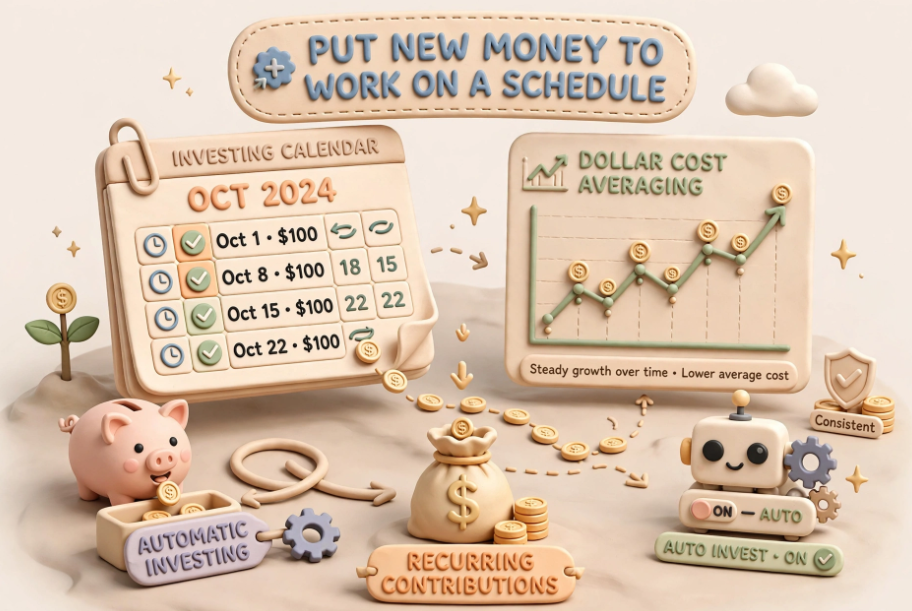
If you already have a large lump sum to invest rather than ongoing paycheck contributions, the math and the psychology point in slightly different directions — investing it all at once is, on average, more likely to produce a better outcome over time than spreading it out, simply because markets rise more often than they fall. But “more likely to be better on average” and “the choice that lets you actually sleep and stick with your plan” aren’t always the same choice, and the second one matters more than people give it credit for, because a strategy you can’t emotionally follow through on isn’t actually a strategy.
Step 7: Maintain It — Rebalancing and Ongoing Tax Management
A portfolio isn’t a decision you make once. Different holdings grow at different rates, and left alone, your carefully chosen allocation drifts — a portfolio that started at 80% stocks and 20% bonds can quietly become 90/10 after a strong few years for stocks, taking on more risk than you originally signed up for without you doing anything at all. The SEC recommends rebalancing back to your target either on a regular schedule, commonly every six to twelve months, or whenever an allocation drifts past a threshold you set in advance, whichever comes first — and frames the mechanical benefit precisely: rebalancing “forces you to buy low and sell high,” systematically, because it directs new money and trims toward whatever has become underweight or overweight relative to the plan.[1]
In a taxable account, rebalancing and tax management need to happen together, not separately, because selling a winning position to rebalance can trigger a capital gains bill you didn’t need to create. Directing new contributions toward whatever’s currently underweight, rather than immediately selling the overweight position, is often the lower-cost way to rebalance in a taxable account — and pairing that with periodic tax-loss harvesting on any positions that are actually down can help offset gains elsewhere in the portfolio. Discipline is the harder half of this step, not the mechanics. Vanguard’s own research on investor behavior during the sharp 2020 market decline found that investors who panic-sold near the bottom realized roughly a -2% return over the following period, compared to about 21% for those who stayed disciplined and held their allocation through the recovery — a stark, real illustration of why the plan only works if you actually follow it when it’s uncomfortable to do so.[2]
The Mistakes That Derail Most DIY ETF Portfolios
- Buying funds one article at a time with no allocation plan. This is the starting problem this whole guide addresses — a portfolio built from individually reasonable decisions with no coordinating framework often ends up with unintended overlap, unintended gaps, or an unintended risk level nobody actually chose.
- Chasing last year’s best-performing fund or sector. By the time a strong run is visible and popular enough to chase, a meaningful part of it has often already happened — and concentrating new money into whatever just performed best is a subtle way of buying high, repeatedly.
- Ignoring costs because they look small. A 0.3-percentage-point difference in expense ratio looks negligible on a statement and compounds into a genuinely large gap over a multi-decade holding period, as our cost calculator makes concrete.
- Holding the wrong assets in the wrong account. The same fund can cost meaningfully more or less depending on whether it sits in a Roth account, a traditional account, or a taxable one — a decision covered in Step 2 that’s easy to skip past on the way to picking funds.
- Reaching for leveraged or inverse funds as a “faster” version of a core position. These products are built to hit a daily target, not a long-term one, and their behavior over months or years can diverge sharply from what their name suggests — a mechanism explained in the SEC and FINRA’s own joint investor bulletin on the subject.[6] They’re built for short-term, actively managed positions, not as a substitute for a core holding.
- Never rebalancing, or rebalancing emotionally instead of on a plan. A portfolio that’s never rebalanced isn’t the portfolio you designed anymore; it’s whatever the market happened to turn it into.
When to Update the Plan Outside Your Regular Schedule
The six-to-twelve-month rebalancing check handles drift — the normal, expected process of some holdings growing faster than others. It doesn’t handle the fact that the underlying answers from Step 1 and Step 2 can themselves change, and when they do, waiting for the next scheduled check isn’t really the right response. A handful of events are worth treating as a trigger to revisit the whole framework, not just rebalance within it.
A significant change in time horizon is the clearest trigger — getting within about five to ten years of a goal you’re investing toward (retirement, a home purchase, a child’s education) generally calls for a deliberate reduction in stock exposure and increase in bonds and cash, on a glide path rather than all at once. Our guide to building and managing a retirement portfolio through every stage covers this transition in more depth. A change in account access — a new job with a 401(k) match, or the loss of one — changes Step 2’s answer and often means restructuring which holdings sit where. A major change in income or expenses changes how much risk you can actually afford to take, separate from how much you’re psychologically comfortable with. And living through an actual market decline for the first time is, honestly, often the most reliable test of whether your stated risk tolerance from Step 1 was accurate — if a real decline made you seriously consider selling everything, that’s real information your original allocation should probably account for, not a failure to feel guilty about.
None of these triggers mean abandoning the framework — they mean re-running Steps 1 and 2 with updated honest answers, then letting Steps 3 through 7 follow from there, the same way they did the first time.
A Complete Example, Worked Through Step by Step
To make the framework concrete, here’s how it might come together for a hypothetical investor — not a recommendation for you specifically, since your own answers to Step 1 and Step 2 will differ, but a worked illustration of how the pieces connect.
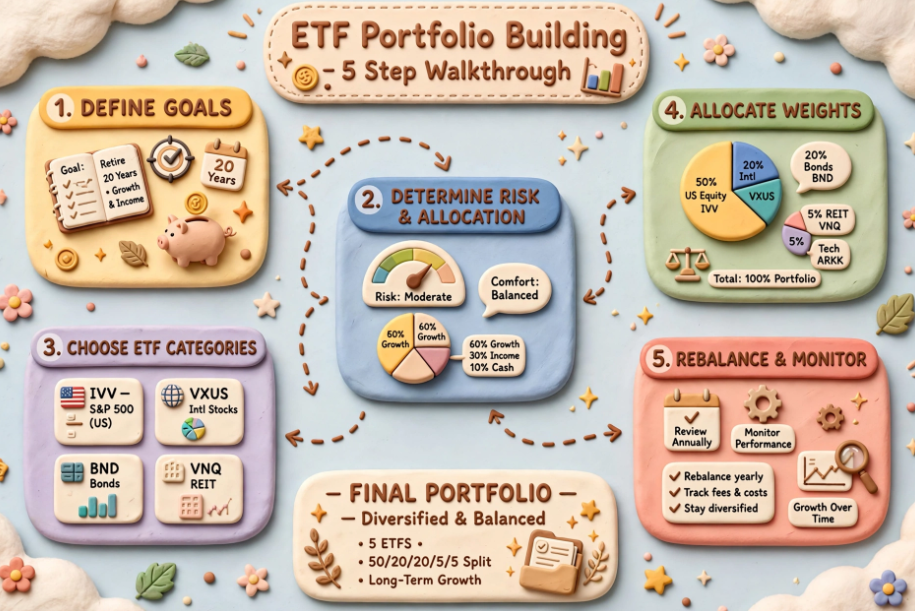
Imagine a 30-year-old investor with a long time horizon (retirement roughly 35 years away), moderate-to-high risk tolerance confirmed by having lived through at least one real market decline without panic-selling, access to a Roth 401(k) at work with an employer match, and a taxable brokerage account for savings beyond that. Working through the steps above: Step 1 suggests a stock-heavy allocation given the long horizon and confirmed risk tolerance. Step 2 suggests prioritizing the employer match first (it’s an immediate, guaranteed return), then favoring the Roth account for the highest-growth-potential holdings since decades of growth would come out completely tax-free, and using the taxable account for more tax-efficient, broad index holdings. Step 3 points toward low-cost, broad index funds as the default, reserving the extra due diligence for anything outside that core. Step 4 might land on a core split of roughly 70% U.S. total market, 20% international, and 10% bonds — heavier on stocks given the long horizon, with international exposure sized according to their own read of the debate in our VTI vs. VXUS guide. Step 5 might add a small single-digit-percentage sector or thematic satellite position, sized deliberately so a bad year in that satellite doesn’t meaningfully alter the whole plan. Step 6 means automating contributions from every paycheck rather than trying to time entries. Step 7 means a calendar reminder every six months to check the allocation against the original targets, and directing new contributions toward whatever’s underweight instead of selling to rebalance in the taxable account.
Change the inputs — a shorter time horizon, lower risk tolerance, no employer plan, a large existing taxable position — and several of these answers change with them. Consider a second, contrasting investor: 55 years old, planning to retire around 65, with most of their retirement savings in a traditional 401(k) and a smaller taxable account, and a risk tolerance that’s genuinely lower now than it was at 30, not just theoretically lower. Step 1 now points toward meaningfully less stock exposure and a real allocation to bonds, since the money will be needed on a horizon closer to a decade than three. Step 2 shifts too — the traditional 401(k)’s tax-deferred growth is now less about maximizing decades of compounding and more about managing what withdrawals will look like fairly soon, which is where our retirement portfolio guide picks up in more detail. Step 4’s core might land closer to 50% stocks and 50% bonds rather than the 30-year-old’s 90/10 split, with the bond sleeve doing real, deliberate work rather than sitting at a token allocation. Step 5 gets more conservative too — a satellite position that was a reasonable, contained bet at 30 carries more relative weight against a shorter recovery window at 55, which is a real reason to trim it, not just a vague sense that “less risk is safer.” The steps didn’t change between these two investors. Nearly every answer inside them did.
That’s the actual point of a framework over a fixed model portfolio: the process stays the same, but your honest answers at Steps 1 and 2 are what should be doing most of the work in Steps 4 and 5, not a generic percentage copied from an article — including this one.
Frequently Asked Questions
How many ETFs do I actually need? There’s no fixed number, but a well-built core often runs three to five funds. More funds than that usually add overlap and complexity rather than meaningfully more diversification, unless each addition is serving a specific, deliberate role.
How often should I check my portfolio? For maintenance purposes, every six to twelve months is generally enough, per the SEC’s own rebalancing guidance.[1] Checking daily tends to increase anxiety and the temptation to make emotional, off-plan changes far more than it improves outcomes.
Is a three-fund portfolio really enough? For a large share of long-term investors, yes — it captures the vast majority of the diversification benefit available, at very low cost. Whether to add anything beyond it is a question of specific goals and conviction, not a sign the three-fund approach is incomplete on its own.
What’s the single biggest mistake to avoid? Based on everything above, it isn’t any one fund choice — it’s skipping Steps 1 and 2 and jumping straight to fund selection. A portfolio built without a clear time horizon, risk tolerance, and account strategy behind it tends to require far more correction later than one built in the right order the first time.
References
- U.S. Securities and Exchange Commission, “Beginners’ Guide to Asset Allocation, Diversification, and Rebalancing.”
- Vanguard, “Four timeless principles for investing success.”
- Internal Revenue Service, Publication 590-A, “Contributions to Individual Retirement Arrangements (IRAs).”
- Investment Company Institute, “Mutual Fund and ETF Fees Remained Near Historic Lows in 2025.”
- Fidelity, “Understanding an ETF’s spreads and volumes.”
- U.S. Securities and Exchange Commission & FINRA, “Updated Investor Bulletin: Leveraged and Inverse ETFs.”
This article is provided for general informational and educational purposes only and is not a recommendation to buy or sell any security, and the hypothetical investor example above does not represent personalized advice for any individual. Figures and guidance referenced above reflect the sources cited as of the “last updated” date and are subject to change. Always do your own research and consult a licensed financial advisor before making investment decisions. Read our full Disclaimer and Privacy Policy for more information.
About the Author
Miguel Ángel Cibeira researches and writes every article on The Fund Atlas personally, sourcing data directly from fund issuers, the IRS, the SEC, and the Federal Reserve. He is not a licensed financial advisor, broker-dealer, or RIA — this site offers independent research and general information, not personalized financial advice. Read the full bio →